Roofing Terms Every Homeowner Should Know
Your roofing estimate says “24 squares, one-layer tear-off, and ice-and-water shield at the eaves”. If none of that means anything to you, this list is coming to the rescue. You might find the roofing terms below in your contractor’s estimate, the manufacturer’s warranty paperwork, or an insurance adjuster’s scope.
Many of these words decide what you pay. A “tear-off” instead of an “overlay” can change a quote by several thousand dollars, and whether your policy pays replacement cost or actual cash value decides who absorbs the depreciation on a 15-year-old roof. Every term below is listed alphabetically.
What Roofing Terms Should a Homeowner Know?
The most common ones that might show up on your paperwork include square (100 square feet of roof), pitch (how steep it is), tear-off versus overlay (whether the old roof comes off or gets a new layer of shingles), decking, underlayment and flashing (the layers underneath), and RCV versus ACV (whether insurance pays full replacement or subtracts for age).
Those seven terms are behind most of the budget allocation on a roofing job. The full A-to-Z list follows.
Jump to: A | B | C | D | E | F | G | H | I | L | M | N | O | P | R | S | T | U | V | W
A
ACV (actual cash value)
What a repair costs to replace, minus depreciation for age and wear. The difference between replacement cost and actual cash value coverage is the biggest variable in a roof claim payout, and actual cash value often doesn’t cover the full repair.
Adjuster
The person your insurance company sends to inspect the damage and decide what the policy covers. They write the scope, and their report is the basis of the payout.
Apron flashing
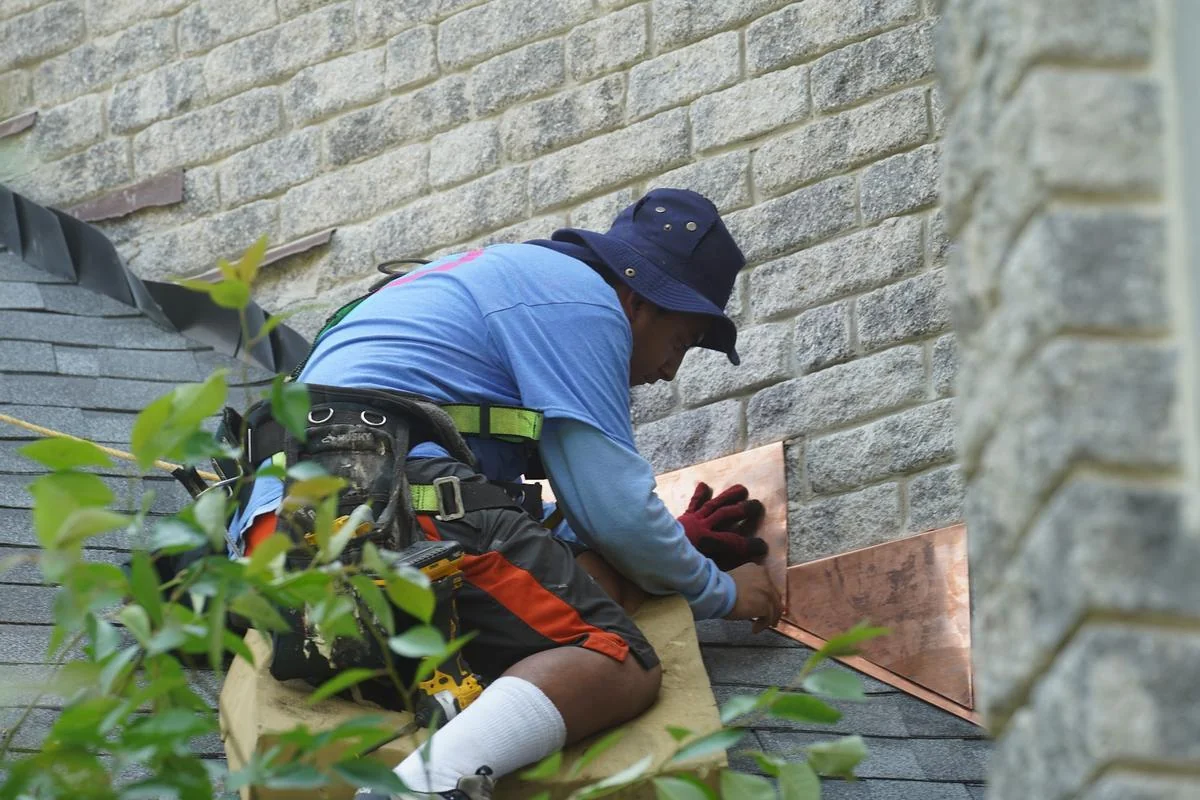
The metal that sits at the base of a chimney or a wall where it meets the roof slope, carrying water out and away from the joint.
Architectural shingle
A thicker shingle built from two bonded layers, giving a dimensional look and generally a longer warranty than the flat kind. Also called dimensional or laminated shingles, architectural shingles are the most common material on replacement roofs.
Asphalt shingle
The standard residential roof covering in the U.S: a fiberglass mat coated in asphalt and surfaced with mineral granules. Asphalt shingles come in three-tab and architectural grades.
Attic ventilation
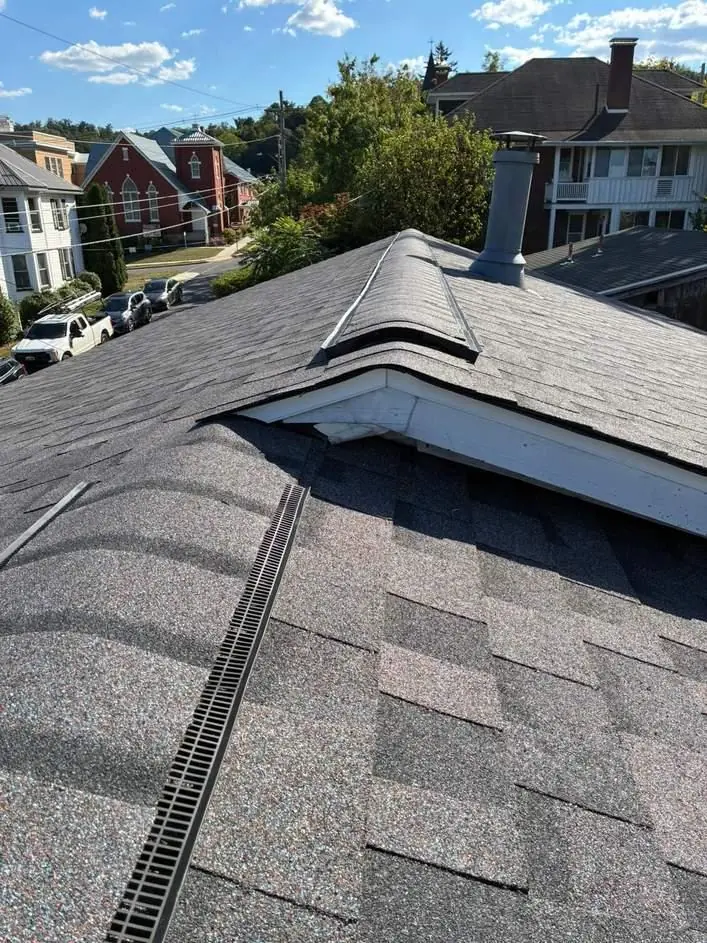
The intake and exhaust vents that move outside air through the attic. Without it, heat and moisture build up and shorten the life of the shingles from underneath.
B
Blistering
Small raised bubbles in a shingle’s surface, caused by trapped moisture or gas escaping. Blisters that pop leave bare spots where granules are gone.
Boot
The flexible collar that seals around a pipe coming through the roof. Boots crack with age and are a common source of a mystery leak.
Buckling
A wavy, rippled look across a roof plane, usually from wrinkled underlayment or displaced decking. It signals a problem underneath the shingles.
C
Certified contractor
A roofer that a manufacturer has trained and approved to install their products. With most manufacturers, only certified contractors can register the extended warranties.
Change order
A written amendment to the contract covering work that wasn’t in the original scope, with its own price. Nothing extra should get done without one.
Counter flashing
The second piece of flashing, set into a chimney or wall above the base flashing, that caps it and stops water from getting behind it.
Courses
The horizontal rows of shingles, counted from the eave up to the ridge.
Cricket
A small peaked structure built behind a chimney to split water around it instead of letting it pool against the back wall.
Curling
Shingle edges lifting or cupping upward as they age and dry out. Curled shingles catch wind and are one of the clearest signs a roof is nearing the end of its life.
D
Decking
The plywood or board base nailed across the rafters, under everything else. Also called sheathing, soft or rotted roof decking gets replaced before new shingles go down, which is a common reason a final bill is higher than the estimate.
Deductible
The amount you pay yourself on an insurance claim before coverage starts. A contractor offering to absorb it is a warning sign, and it’s prohibited outright in some states.
Delamination
The layers of a laminated shingle separating from each other, or plywood decking coming apart in plies. Either way, the material needs to be replaced and won’t hold fasteners reliably.
Depreciation
The dollars subtracted from replacement cost for age and wear. On a replacement cost policy, the insurer usually holds that amount back and releases it once the work is finished. On an actual cash value policy, it isn’t paid at all.
Dormer
A boxed-out structure with a window that projects from a roof slope. Each dormer adds edges that have to be flashed and sealed, so they’ll raise the price of a roofing job.
Drip edge
The metal strip along the eaves and rakes that tips water off the edge into the gutter instead of behind it. A missing drip edge rots the board behind the gutter over time, and many building codes now require one.
Dry-in
Getting the underlayment and flashing on so the structure is weather-tight before the final roofing goes down. On a multi-day job, this is why an open roof doesn’t mean your house is vulnerable to the elements.
E
Eave
The lower edge of the roof that overhangs the wall, and where the gutters mount.
Exposure
How much of each shingle is left visible once the row above overlaps it. If a contractor gets this wrong, it changes how the roof sheds water and how many shingles the job takes.
F
Fascia
The upright board along the eave that holds the gutter screws. Rotted fascia means the gutter has nothing solid to attach to.
Felt
The traditional asphalt-saturated paper underlayment, sold in 15-pound and 30-pound weights. Most new roofing projects now use synthetic underlayment.
Flashing
Thin metal installed wherever the roof meets a wall, a chimney or a vent pipe. Loose or separated roof flashing is often the culprit when a roof leaks but the shingles still look fine.
G
Gable
The triangular section of wall between two slanted roof edges.
Granule loss
Bare or shiny patches on a shingle where the grit has worn off, or grit collecting in the gutters. It exposes the asphalt to sunlight, and the shingle ages quickly from there.
Granules
The mineral grit bonded to a shingle’s surface. It’s responsible for the color of the roof and shields the asphalt underneath from sunlight.
H
Hail bruising
A soft, dented spot where a hailstone struck hard enough to fracture the base mat under a shingle. It often can’t be seen from the ground, which is why homeowners often don’t notice hail damage until a leak starts.
Hip
A slanted peak where two slopes meet at an outside corner. Gable and hip shapes are the two most common types of roofs.
Hip and ridge cap shingles
The purpose-made cap shingles that fold over hips and the roof ridge to close them off.
I
Ice-and-water shield
A sticky waterproof membrane applied at the eaves and in the valleys of a roof. In cold climates, it’s the layer that stops water backing up under shingles behind an ice dam, and code frequently requires it.
Ice dam
A ridge of refrozen meltwater at the roof edge that traps water behind it. The water then works back under the shingles, which is why ice-and-water shield exists.
Intake vent
A vent low on the roof, usually in the soffit, that lets outside air in. Exhaust vents at the ridge can’t do their job without it.
L
Low-slope section
Any part of the roof that’s flatter than about 3/12. Standard shingles don’t shed water reliably at that angle, so these areas usually need a special membrane material (priced separately).
M
Magnetic sweep
Running a magnet over the yard and driveway at the end of the job to pick up dropped nails. Ask whether it’s included, because it’s the difference between a clean site and a flat tire.
Manufacturer warranty
The shingle maker’s guarantee that covers defects in the product itself, like shingles that crack or lose granules early. It doesn’t cover poor installation.
Matching
Whether replacement materials have to reasonably match the undamaged parts of the roof. If your shingle is discontinued and only one slope is approved, matching is the argument for a fuller repair. Coverage varies by state and by policy.
Metal panels
A metal roof formed from long formed-metal sheets rather than individual shingles. Standing seam is the version with raised interlocking seams and no exposed fasteners.
N
Nail pop
A fastener that’s backed out and is pushing a bump up under the shingle above it. Each one is a small hole waiting to leak.
O
Overhang
How far the roof extends past the exterior wall. It shades the siding and lets water run off the roof clear of the foundation.
Overlay
Laying new shingles straight over the existing shingles instead of removing the old layer. It’s cheaper up front, it hides whatever is wrong with the decking, and it adds weight. Many building codes don’t allow it when the roof already has two or more layers, or when the existing surface is water-soaked or deteriorated. Also called a re-roof.
P
Penetration
Anything passing through the roof surface: vent pipes, exhaust fans, chimneys, skylights. Each one needs its own flashing, so a roof with many penetrations takes longer to build or replace.
Permit
Local authorization to do the work, pulled before the job starts. The contractor normally pulls it, and the contract should say so.
Pitch
How steep the roof is, written as a ratio like 6/12, meaning it rises 6 inches for every 12 inches across. Steeper roofs need more fall protection and slower work, so labor costs more. Also called slope.
Ponding water
Water still standing on a low-slope roof section more than about two days after rain. It means the roof isn’t draining and the membrane is sitting in water.
Proof of loss
The sworn statement of what you’re claiming, signed by you as the policyholder. It’s your document, and nobody can sign it for you.
Prorated coverage
A warranty structure where the manufacturer’s share of a replacement shrinks as the roof ages. Ask directly whether a warranty is prorated, and from what year the reduction starts.
R
Rafter
One of the sloped structural beams that hold up the decking. Cut on site, as opposed to a factory-built truss.
Rake
The slanted edge running from the eave up to the peak at the end of the house.
RCV (replacement cost value)
What it costs to repair or replace the damage using materials of similar kind and quality, with nothing deducted for age. This is the better of the two coverage types.
Recoverable depreciation
The withheld depreciation an insurer releases after you finish the approved work and send proof. Miss the deadline and you forfeit it.
Ridge
The horizontal peak where two slopes meet at the top.
Ridge cap
The shingles that fold over the peak. Some crews cut down standard shingles for this, and manufacturers also sell purpose-built cap shingles. A careful estimate may even detail which of these you’ll be getting.
Ridge vent
The vent running along the peak that lets hot, damp attic air out. A ridge vent only works when intake vents feed it air.
S
Scope
The adjuster’s itemized list of the damage they’re approving and the repairs they’ll cover. Damage that isn’t in the scope doesn’t get paid for, so document everything.
Self-seal strip
The band of adhesive on a shingle that bonds it to the course below once the sun warms it. It’s what keeps shingles secured in the wind.
Sheathing
Another word for decking.
Soffit
The panel closing in the underside of the eave overhang. A vented soffit feeds air into the attic.
Square
100 square feet of roof area. Roofers price materials and labor by the square, so “24 squares” means 2,400 square feet of roof surface. It’s the most useful number to understand on any estimate because it lets you compare two bids equally.
Starter strip
The first row along the eave that goes down before the visible shingles. It seals that bottom edge so wind can’t lift it.
Step flashing
Individual bent pieces of metal woven in with the shingle courses where a roof slope runs alongside a wall. Continuous flashing used in place of step flashing is a common installation shortcut and a notorious source of leaks.
Supplement
An additional request your contractor will submit when a repair reveals damage the original scope missed. Rotted decking under old shingles is the standard example, since nobody can see it until you remove the shingles and underlayment.
System warranty
A stronger manufacturer warranty. You can qualify for it by using a full set of one manufacturer’s components, installed by a contractor they’ve certified.
T
Tear-off
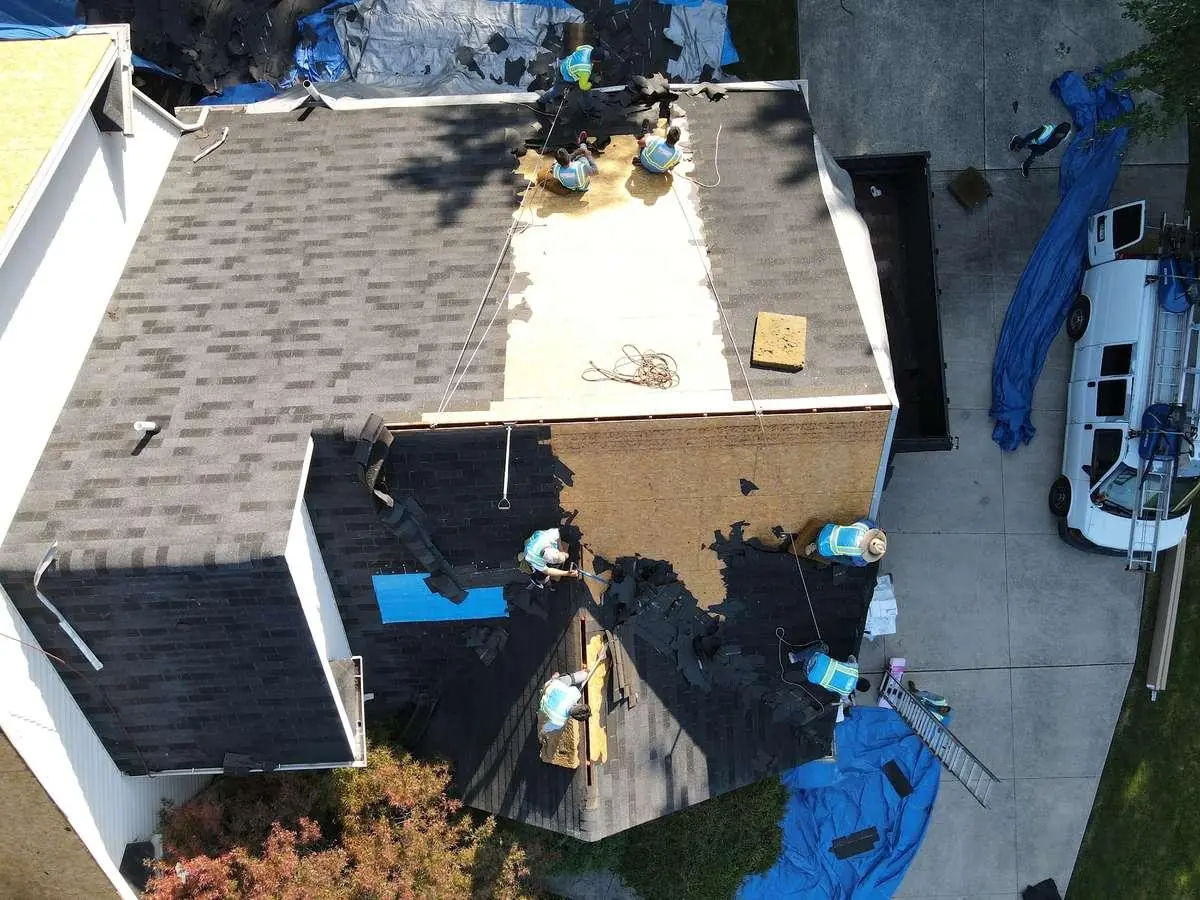
Stripping the old roofing down to bare decking before the new roof goes on. It adds disposal cost to your estimate, and it’s the only way the crew sees the condition of the wood underneath.
Three-tab shingle
The older flat, single-layer shingle with cutouts that make it look like three pieces. Three-tab shingles cost less than architectural shingles and come with shorter warranties.
Truss
A factory-built triangular frame that supports the roof, delivered whole and set in place. Never cut or modify one without an engineer.
U
Underlayment
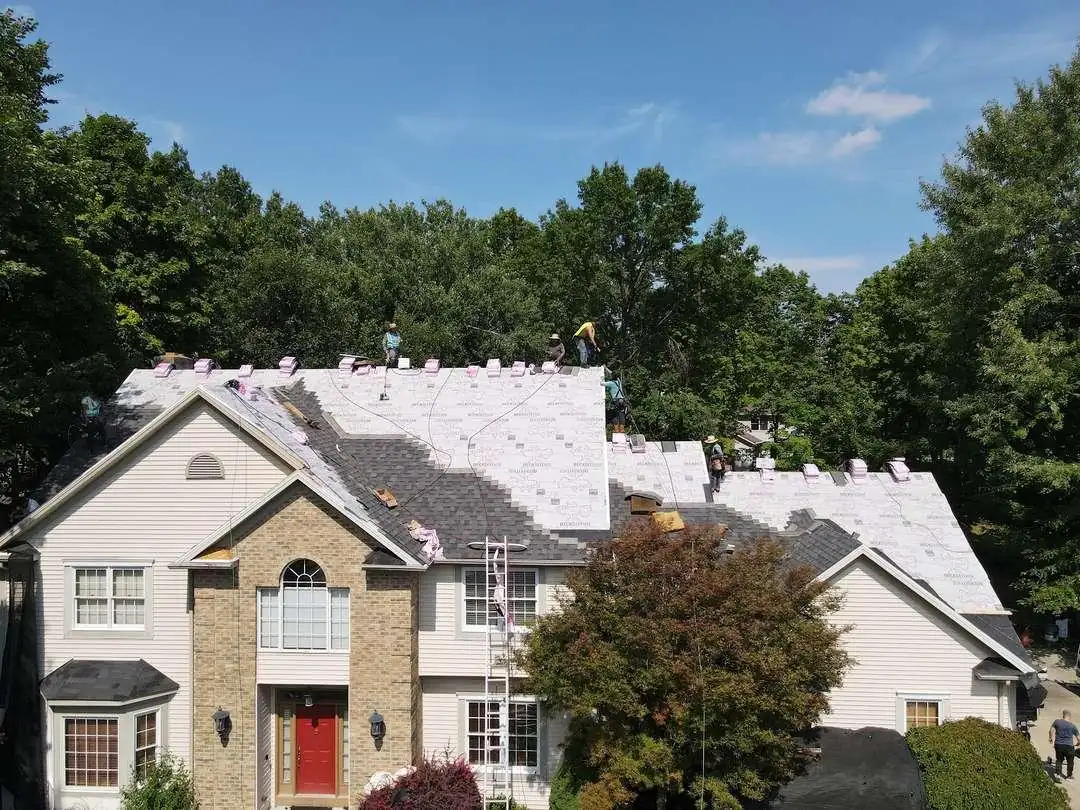
The water-resistant sheet rolled over the decking, under the shingles, that catches any water the shingles let through. The types of roof underlayment differ in material, price, and how long they last.
Uplift
Wind getting under a shingle edge and peeling it back. Shingle wind ratings measure resistance to uplift. Wind damage usually starts at an edge or a corner.
V
Valley
The interior channel where two slopes meet, and the part of the roof that carries the most water.
Vent
Any opening that moves air into or out of the attic. Box vents, turbine vents and ridge vents are the common exhaust types.
W
Waste factor
The percentage added to material quantities to cover cuts and offcuts (leftovers cut from your roof materials). It’s an expected line on an estimate and may be a higher percentage on a complicated roof.
Workmanship warranty
The contractor’s guarantee that covers installation errors; for example, if flashing was installed improperly and the roof leaks as a result. Roof warranty terms vary enormously between companies. The Genius Limited Lifetime Warranty from Home Genius Exteriors guarantees the installation itself, separate from the manufacturer’s warranty on the shingles.
How to Use These Roofing Terms on an Estimate
Once you’ve read the estimate, you’ll probably have many questions for your roofer. Be sure to ask these three first:
- How many squares is the contractor quoting?
- Are they recommending a tear-off or overlay?
- What happens to the cost and timeline if the decking underneath needs replacement?
If you find an obscure term we haven’t defined on this page, you can also consult this full technical roofing glossary.
Bring This List to Your Next Roofing Estimate
Home Genius Exteriors provides free inspections that tell you, in plain language, what your roof needs now and what can wait. The team will walk the roof, photograph what they find, and describe the condition of the shingles, flashing and ventilation. Schedule your free inspection and get a straight answer about what your roof needs.
Frequently Asked Questions
What are the parts of a roof called?
The main parts are the eave (lower edge), rake (slanted end edge), ridge (top peak), hip (angled peak at a corner), valley (channel where two slopes meet), decking (the wood base), underlayment (the water-resistant layer), flashing (metal at the seams), drip edge, soffit and fascia.
What are some common slang terms used in roofing?
Roofers shorten things constantly. A “square” is 100 square feet, “tear-off” is stripping the old roof, “re-roof” or “overlay” is a layer over the old shingles, “ice and water” is the waterproof membrane at the eaves, “dry-in” is getting it weather-tight, and “cap” is the shingle that folds over the ridge.
What are some common technical terms used in roofing?
The technical vocabulary covers measurement and materials: pitch or slope written as a ratio like 6/12, squares for area, exposure for how much of each shingle shows, penetrations for anything passing through the roof, underlayment, ice-and-water shield, starter strip, step flashing, hip and ridge cap, and low-slope membrane. We define all of these terms higher up on this page.
What are some words related to roofing?
Start with the ones commonly found on your paperwork: square, pitch, tear-off, overlay, decking, underlayment, flashing, drip edge, ridge, valley, soffit and fascia. On an insurance claim, add scope, adjuster, deductible, depreciation, RCV and ACV. Each one is defined in the A-to-Z list above.