K Style Gutters vs. Half-Round Gutters
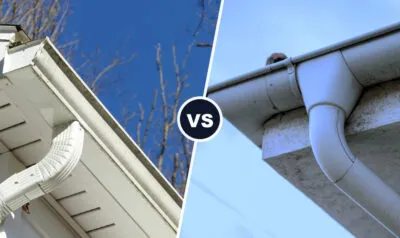
K style gutters are the most common residential gutter in the United States. The flat-backed, crown-molding-shaped profile dominates new construction because contractors stock it and big-box stores sell it by the foot. But popularity doesn’t equal the best fit for every situation.
Your gutter’s shape determines how much water the system handles during a heavy downpour, how easily debris clears between cleanings, and which gutter guards you can use. A wrong-sized gutter on a steep 2,500-square-foot roof can overflow in a moderate storm even with top materials, and on a historic Craftsman bungalow, the wrong profile can undercut a renovation that got everything else right.
Which Is Better: K-Style or Half-Round Gutters?
K style gutters hold roughly 40% more water than half-round gutters of the same width, cost less to install ($8-12 vs. $9-18 per linear foot for aluminum), and work with a wider range of gutter guards.
Half-round gutters clean more easily, suit historic and pre-war architecture, and last longer in copper or zinc.
Choose K style for performance and budget; choose half-round for architectural accuracy.
A 2,000-square-foot roof in a heavy storm can send well over a thousand gallons an hour toward your gutters. The K style’s flat bottom channels water more directly toward downspouts, which reduces the chance of overflow at corners and seams.
| Feature | K-Style Gutters | Half-Round Gutters |
|---|---|---|
| Profile Shape | Flat back, ogee front (resembles crown molding) | Semi-circular trough, open U-shape |
| 5-Inch Water Capacity | About 1.2 gallons per foot | About 0.7 gallons per foot |
| 6-Inch Water Capacity | About 2.0 gallons per foot | About 1.2 gallons per foot |
| Installed Cost (per linear foot) | $8-12 (aluminum) | $9-18 (aluminum) |
| Best Home Styles | Ranch, colonial revival, contemporary, most new builds | Historic, Craftsman, Tudor, Mediterranean, colonial |
| Cleaning Ease | Harder (corners trap debris) | Easier (smooth trough sheds debris) |
| Common Materials | Aluminum, vinyl, steel, copper | Aluminum, copper, galvanized steel, zinc |
| Gutter Guard Compatibility | Excellent (wide selection) | Limited (requires specialty guards) |
| Installation Mounting | Hidden hangers, fascia-mounted | External brackets or hidden hangers |
The K style profile’s flat bottom and angled sides create a larger cross-sectional area than a half-round gutter of the same nominal width. A standard 5-inch K style gutter holds roughly 1.2 gallons per linear foot, while a 5-inch half-round holds closer to 0.7 gallons, about 40% less at the same width. This difference in capacity is why a K style system can drain a considerably larger roof area than a half-round of the same size before it starts to overflow. Building codes size gutters to the roof area they drain for exactly this reason.
That being said, half-round gutters aren’t disqualified from rainy climates. Upsizing to a 6-inch half-round brings capacity to roughly 1.2 gallons per foot, matching the 5-inch K style. If you prefer the half-round look, upgrading one size and adding an extra downspout every 20 feet compensates for the smaller cross-section. The tradeoff is cost: a 6-inch half-round system installed in copper or steel can run three to four times the price of a standard 5-inch K style aluminum setup.
Cost, Materials, and Installation
K style gutters cost less primarily because of supply chain volume. Every seamless gutter machine on a contractor’s truck runs K style by default, and aluminum coil stock is inexpensive. Expect $8-12 per linear foot installed for aluminum K style, including hangers and downspouts. Vinyl K style drops lower at $4-7 per foot, though vinyl’s UV degradation and cracking in cold climates make it a poor long-term investment for most homeowners in the Mid-Atlantic and Northeast.
Half-round systems start around $9 per linear foot for aluminum and climb quickly with premium metals. Copper half-round gutters, the standard choice for historic restorations, cost $25-40 or more per foot installed. Half-round gutters require external brackets spaced every 24 to 30 inches, and those brackets cost more than hidden hangers. Fewer contractors carry half-round tooling, so labor rates often reflect a specialty markup.
Labor for half-round installations tends to run 20 to 40 percent higher than comparable K style jobs, one of several factors that shape overall gutter installation cost.
Regardless of which gutter type you choose, ask your installer how they set the gutter pitch (typically 1/4 inch of drop per 10 feet of run), how they seal end caps, and whether they run a hose test before leaving. Poor pitch is one of the most common causes of standing water and fascia damage, and it’s invisible until the first heavy rain.
Which Materials Work Best for Each Gutter Style
Aluminum suits both K style gutters and half-round gutters, and it covers the majority of residential jobs. For K style, aluminum and vinyl dominate, and the tradeoffs between the two mirror the broader comparison of aluminum versus vinyl gutters. For half-round, aluminum stays the budget pick, but copper and zinc drive the price up significantly. Many homeowners love the look regardless: half-round copper gutters develop a natural protective patina that pairs well with slate roofs and stone facades.
Galvanized steel works for both shapes but needs more maintenance to prevent rust. Zinc is a premium half-round option popular in European-influenced architecture, with a service life that can exceed 50 years and require almost no upkeep. If you’re choosing half-round gutters for a historic home, copper or zinc justify the cost due to how long the gutters last and their period-appropriate appearance. On K style systems, painted aluminum provides the best balance of durability and value.
Which Gutters are Easier to Maintain?
Half-round gutters are much easier to clean. The smooth, curved trough has no interior corners or folds where wet leaves can compact and decompose. Debris tends to sit loosely and flush toward outlets with each rain. A quick pass with a garden hose clears most buildup.
K style gutters have two sharp interior corners where the flat bottom meets the angled sides. Wet debris wedges into those creases, creating blockages that require hand scooping or pressure washing. Over time, standing organic matter in K style corners accelerates corrosion and can stain fascia boards.
Gutter guard compatibility tilts strongly toward K style. The flat, rigid lip of a K style gutter accepts snap-on mesh screens and reverse-curve covers without modification. Half-round gutters require specialty guards designed for a curved rim, and the selection is much smaller. If you’re considering guards as a long-term maintenance solution, keep in mind that there’s a greater range of gutter guard types available for K style.
Best Gutter Shape by Home Style, Climate, and Priority
Architecture should drive your choice. The wrong gutter profile can undercut curb appeal on an otherwise well-executed renovation.
Historic vs. Modern Architecture
Half-round gutters are the right choice here, without exception. If your home was built before 1940 or follows Craftsman, Tudor, or Mediterranean design, half-round gutters match the architectural intent. Many local historic preservation boards require half-round profiles on designated properties.
The Secretary of the Interior’s Standards for Rehabilitation direct property owners to preserve historic exterior character. K style gutters on a 1920s bungalow would look as out of place as three-tab asphalt shingles on a brownstone.
K style gutters complement most post-war and contemporary residential architecture. The ogee profile mimics crown molding, giving the roofline a finished look that blends with brick and stucco alike. For ranch homes, split-levels, and contemporary builds, K style is the standard for good reason: it’s affordable, widely available in matching colors, and handles the water volume generated by large suburban roofs.
K Style or Half Round Gutters: What are Your Priorities?
Your home’s architecture should guide the decision, but other factors can tip the scale. Weigh these priorities:
- Lowest cost: K style aluminum, 5-inch. Budget option that fits most homes.
- Lowest maintenance: Half-round aluminum or copper. Fewer clogs and easier cleaning.
- Maximum capacity: 6-inch K style. Best for large roofs and heavy rainfall areas.
- Historic accuracy: Half-round in copper or zinc. Non-negotiable for period restorations.
- Best gutter guard options: K style. Far wider selection of compatible guard systems.
- Snowy climates: K style with oversized downspouts. The flat bottom resists ice dam deformation better than curved profiles.
Homeowners who choose based on aesthetics alone sometimes end up with a beautiful half-round system that overflows twice a year because their roof area actually needs K style capacity. Match the profile to the performance requirement first, then consider the aesthetic preference.
5-Inch vs. 6-Inch Gutters
Sometimes the bigger decision is 5-inch versus 6-inch, not K style versus half-round. A 6-inch K style gutter holds roughly 2.0 gallons per linear foot, nearly triple the capacity of a 5-inch half-round. For homes with roof areas above 1,500 square feet or in regions that see intense, high-volume downpours, jumping to 6-inch gutters prevents overflow regardless of profile shape.
If you’re torn between a 5-inch K style and a 6-inch half-round, the 6-inch half-round actually has K style capacity with a cleaner look—perfect if you’re willing to pay the premium. Pair oversized gutters with 3×4-inch rectangular downspouts (for K style) or 4-inch round downspouts (for half-round) to avoid bottlenecking at the outlets.
K-Style or Half-Round Gutters: It’s Your Call
K style gutters are the go-to for most homeowners. They hold more water, cost less, pair with nearly every gutter guard on the market, and suit most modern residential architecture. If budget and performance top your priority list, K style aluminum is your best bet.
For historic properties and any project where architectural integrity is important, the smooth curved profile of half-round gutters is worth every extra dollar. Easier cleaning and the longer lifespan of premium metals like copper and zinc add up over time.
Whichever profile you choose, size it correctly for your roof and rainfall. A beautiful gutter that overflows is worse than a plain one that works. Start by measuring your roof’s square footage, check your region’s rainfall intensity, and then pick the profile that balances performance with the look your home deserves.
Home Genius Exteriors provides free inspections that pinpoint which gutter profile and size fit your roofline and climate. Our team can walk you through K-style and half-round side by side. Call today to schedule your inspection.
*Header image adapted from “Upstate New York Seamless Aluminum Gutters 03” by Stilfehler (CC BY-SA 4.0) and “Roof gutter under cloudy sky with water downspout on a building” by Shixart1985 (CC BY 2.0), via Wikimedia Commons. Cropped, color-adjusted and combined. This composite is licensed CC BY-SA 4.0.
Frequently Asked Questions
Can I mix K style and half-round gutters on the same house?
Yes, mixing profiles can work when you have distinct rooflines or additions with different architectural themes. The key is keeping downspout placement and drainage paths consistent, then choosing a unified color and finish so the system looks intentional.
How do I choose the right gutter color and finish for curb appeal?
Match the gutter color to the fascia or trim for a clean, integrated look, or match the roof color to visually minimize the gutter line. On higher-visibility front elevations, a low-sheen finish typically hides waviness and touch-up marks better than glossy coatings.
Is seamless construction more important than gutter shape?
Seamless gutters have fewer potential leak points, especially on long, straight runs. Shape affects performance and aesthetics, but seam count often drives drip and maintenance issues over time.
What are the most common installation mistakes that cause gutter problems?
Poor slope and loose fasteners are frequent culprits. They cause standing water, overflow, and fascia damage even with the right profile. Ask your installer how they set pitch and seal end caps, and double check the drainage with a hose test before finishing the job.
How do I know if my fascia or roof edge needs repair before installing new gutters?
Look for soft or peeling fascia, rusted drip edge, or rafters that feel spongy when gently probed. Any rot or delamination should be repaired before installing new gutters, because gutters mounted to compromised wood can pull away or let water leak behind the system.
Are rain chains a viable alternative to downspouts with K style gutters or half-round gutters?
Rain chains can work on smaller roof sections or sheltered areas where splash control is manageable. For heavier flows, pair them with a catch basin or decorative drain to prevent erosion and water intrusion near the foundation.
What should I ask a gutter contractor before signing a quote?
Confirm the exact material thickness and warranty coverage for finish and workmanship, and whether they include fascia repairs and permits. Also ask for the planned outlet locations and how they route discharge away from the foundation and walkways.