The Types of Gutter Guards
Most homeowners don’t think about their gutters until a rainstorm turns the roofline into a waterfall. By then, the clog is already packed tight with decomposing leaves, and the only fix seems to be a wobbly ladder and a bucket. If you’ve been researching types of gutter guards to avoid that scenario, you’re asking the right question, but the sheer number of options makes the decision harder than it should be.
The marketing around gutter guards often overpromises. “Never clean your gutters again” is a common sales pitch that holds up poorly in yards with pine trees, heavy pollen, or frequent storm debris. The right guard type for your home depends less on brand and more on what’s falling on your roof.
Quick Answer: What Are the Types of Gutter Guards?
Gutter guards are covers or inserts that reduce how often you need to clean your gutters by keeping debris out of the channel while allowing water to flow through. The six main types are micro-mesh, reverse curve, screen/perforated, bottle brush, foam inserts, and solid cover/helmet systems, each with different price points, debris-handling abilities, and maintenance requirements. Which guard works best can also depend on your choice between aluminum and vinyl gutters, since the two materials hold up differently over time.
Gutter Guard Comparisons
Before getting into the details, this overview table gives you a quick snapshot of how each guard type stacks up. Refer back to it as you read the full breakdowns below:
| Guard Type | Cost per Linear Foot (Installed) | Best For | Maintenance Required | Typical Lifespan |
|---|---|---|---|---|
| Micro-Mesh | $15-$45 | Pine needles, shingle grit, seed pods | Low: occasional surface brushing | 20-25 years |
| Reverse Curve / Surface Tension | $15-$35 | Large leaves, moderate debris | Low-Medium: check nose for clogs | 20+ years |
| Screen / Perforated | $6-$12 | Large leaves on a budget | Medium: seasonal cleaning | 5-10 years |
| Bottle Brush | $2-$4 (DIY only) | Easy DIY, moderate leaf cover | High: debris tangles in bristles | 3-5 years |
| Foam Inserts | $1-$3 (DIY only) | Light debris, budget buyers | High: can trap seeds and moisture | 2-4 years |
| Solid Cover / Helmet | $20-$50+ | Homeowners who want a premium, integrated system | Low: periodic nose inspection | 20-30+ years |
Types of Gutter Guards
Every gutter guard falls into one of six categories. The differences come down to how they separate water from debris, and that design choice determines everything else: cost, durability, and which debris types they handle well.
Micro-Mesh Gutter Guards
Micro-mesh guards use a fine stainless-steel screen, typically 50 to 800 microns, stretched over a support frame that sits on top of the gutter. Water passes through the tiny perforations while even small debris like pine needles and shingle grit stays on top, eventually blowing away or drying and sliding off.
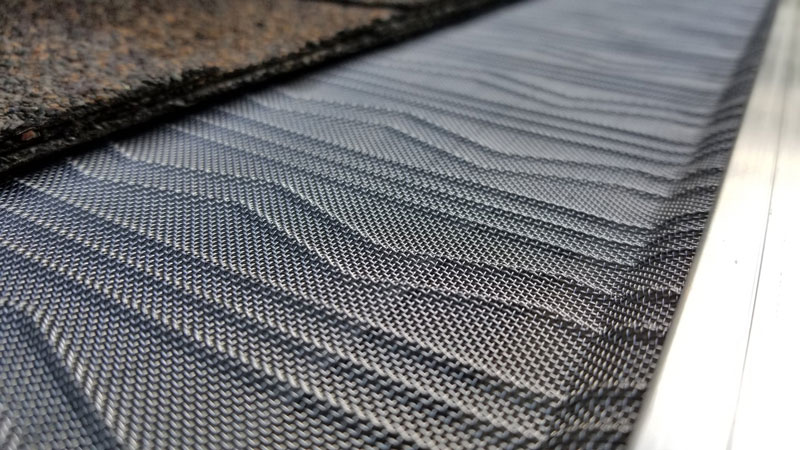
Pros: Best all-around debris filtration. Handles fine particles that defeat other designs, and durable stainless-steel versions resist corrosion for decades.
Cons: Higher upfront cost than basic screens, and the fine mesh can develop surface tension issues that cause water to sheet over the guard during heavy downpours. Professional installation is always recommended for optimal performance.
Micro-mesh is the strongest all-purpose choice for most homes, especially those near conifers. This is the category where premium brands like LeafFilter operate.
Reverse Curve and Surface Tension Guards
These guards use a solid curved cover that directs water around a downward-facing nose and into the gutter via surface tension. Leaves and large debris slide off the curved surface while water clings to the metal and follows the curve inward.
Pros: Excellent at shedding large leaves, with durable construction and a clean roofline appearance.
Cons: They struggle with fine debris like pine needles and shingle grit, which can slip past the nose opening. In heavy rain, water volume can overshoot the curve entirely, creating the same overflow problems you’d have without guards.
Screen and Perforated Metal Guards
The most basic and affordable option. Metal or plastic screens snap onto or slide under shingles, covering the gutter opening with holes large enough to let water through while blocking bigger debris.
Pros: Lowest entry-point price and widely available at hardware stores.
Cons: Small debris passes right through the perforations. Plastic versions warp and degrade in UV light within a few years. Even metal versions require regular cleaning because leaves, especially wet ones, can mat over the surface and block water flow.
Screens make sense as a temporary or budget solution, but expect to replace them within a decade.
Bottle Brush Guards
These cylindrical bristle inserts sit inside the gutter channel. The bristles fill the space, allowing water to flow through while theoretically keeping debris on top where it dries and blows away.
In practice, debris tangles in the bristles rather than sitting neatly on top. Seeds, pine needles, and small twigs work their way into the brush and create a clog that’s even harder to clean than an unprotected gutter. The only real advantage is dead-simple installation: you drop them in with no fasteners required.
Foam Insert Guards
Foam inserts are porous polyurethane blocks cut to fit inside your gutter. Water soaks through the foam while debris stays on the surface.
Pros: Low price and easy install.
Cons: Foam traps moisture, which promotes mold and algae growth inside the gutter. Seeds that land on foam inserts can actually germinate, leaving you with plants growing in your gutters. Foam also degrades in sunlight and needs replacement every two to four years. The maintenance burden ends up higher, not lower, for most homeowners.
Solid Cover and Helmet Systems
Solid covers, sometimes called helmets or hoods, work on the same surface-tension principle as reverse-curve guards but typically replace or fully enclose the existing gutter. LeafGuard, for example, integrates the guard and gutter into a single unit.
Pros: The longest-lasting option with the lowest ongoing maintenance. Handles heavy leaf loads well.
Cons: Highest cost by a wide margin, always requires professional installation, and fine debris can still enter through the nose slot. Overshooting in heavy rain is a known limitation.
Which Gutter Guard Type Handles Your Debris Best?
The “best” gutter guard depends heavily on what falls off your trees. A guard that handles oak leaves beautifully might fail with pine needles. Here’s how each type performs against the most common debris categories.
Pine Needles and Fine Debris
Pine needles are the toughest test for any gutter guard. Their narrow shape lets them slip through screen perforations and wedge into reverse-curve openings. Micro-mesh is the only reliable solution for heavy pine needle environments. Foam and bottle brush guards make the problem worse because needles embed in the material.
Large Leaves and Twigs
Broad leaves from oaks, maples, and similar deciduous trees are the easiest debris to manage. Every guard type handles them reasonably well, though screen guards can develop matting problems with wet leaves. Reverse-curve and solid-cover systems excel here since large leaves simply slide off the curved surface.
Shingle Grit and Roofing Granules
Aging asphalt shingles shed granules that wash into gutters with every rainstorm. This gritty sediment builds up over time and creates a sludge that clogs downspouts. Only micro-mesh with a sufficiently fine screen rating blocks shingle grit effectively. Every other guard type lets granules pass through.
Freeze-Thaw and Winter Performance
Homeowners in the Mid-Atlantic and similar cold climates need to consider how guards perform in winter. Micro-mesh handles freeze-thaw cycles well because the fine screen doesn’t create a significant lip for ice to grab. Reverse-curve and solid-cover systems can accumulate ice at the nose slot in sustained cold snaps, which may temporarily block water flow during melt events.
Regardless of guard type, ice dams are an attic insulation and ventilation issue, not a gutter guard issue. A guard won’t create or prevent them.
How Much Do Gutter Guards Cost?
Professional installation typically runs $6-$50 per linear foot depending on the guard type and your local market. The $6 figure covers basic screens, while $30-$50 applies to premium systems like LeafFilter or LeafGuard. For a home requiring 150 linear feet of gutter guard, expect to pay anywhere from $900-$7,500 installed, separate from what a full gutter installation itself costs if you’re replacing both at once. Bundling guard installation with a Home Genius Exteriors gutter replacement service is usually the most economical solution.
Professional quotes should include gutter inspection and cleaning, fascia condition assessment, and material warranty details.
Are LeafFilter, LeafGuard, and Other Premium Systems Worth It?
Premium gutter guard brands charge $25-$50 per linear foot installed, which means a full-home system can exceed $5,000. Professional gutter cleaning typically costs $150-$300 per service, and most homes need it two to three times per year. Over 20 years, that adds up to $6,000-$18,000 in cleaning costs alone. A quality guard system that cuts cleaning frequency can offset much of its upfront cost for homeowners who currently hire out this work.
The catch is in the warranty language. “Lifetime warranty” terms vary widely. Some warranties cover only the product, not the labor to remove and reinstall it. Others have transferability restrictions that affect resale value. Read the warranty document before signing, and ask specifically what “lifetime” means and whether the warranty transfers to a new owner.
Premium micro-mesh systems are worth the investment for homeowners who plan to stay in their home long-term and have significant tree coverage. If your home has minimal tree exposure, a mid-range micro-mesh product offers most of the benefit at a fraction of the cost.
What Maintenance Do Gutter Guards Require?
No gutter guard completely eliminates maintenance requirements. Even the best micro-mesh guards need an annual visual inspection. Debris accumulates on top of the mesh surface and, in low-slope roof areas, may not shed naturally. A leaf blower or soft brush usually clears the surface in minutes.
Reverse-curve and solid-cover systems require periodic checks of the nose opening where water enters the gutter. Organic buildup at the entry point can reduce water flow over time. Downspout connections should also be flushed annually, since small particles that pass through any guard type settle in downspouts.
Are Gutter Guards Worth It?
The answer depends on three factors: your tree coverage, your home’s height, and how much risk you’re willing to accept from skipped maintenance.
Gutter guards are worth it when:
- Your home sits under or near mature trees that drop debris year-round
- You have a two-story or multi-level home where ladder access is difficult
- You currently pay for professional gutter cleaning multiple times per year
Gutter guards may not be worth it when:
- Your home has minimal tree coverage and gutters rarely clog
- You have a single-story home where gutters are easy to keep clear
- Your gutters are old, damaged, or poorly pitched (fix the gutters first)
The middle ground is where most homeowners land. If you’re cleaning gutters once or twice a year and it’s more annoying than risky, guards mainly buy you convenience. Once cleaning means climbing a ladder you’d rather avoid, or dealing with recurring clogs that lead to overflow, fascia rot, or ice dam buildup, guards become a safeguard against those problems, and that’s when a professionally installed system earns its cost.
How to Choose the Right Gutter Guard for Your Home
Start with your primary debris type, then factor in budget and installation preference.
Step 1: Identify your dominant debris. Walk around your property and note what falls near the roofline. Pine trees mean you need micro-mesh, period. Broad-leaf deciduous trees give you more flexibility across guard types. No significant trees mean you may not need guards at all.
Step 2: Assess your roof and gutter condition. Guards installed on damaged or improperly pitched gutters create new problems. Make sure your existing gutters drain properly before adding a guard system. If your gutters need replacement, consider an integrated system like a solid-cover design. Compare standard and sectional gutter systems before committing to a guard type, so you don’t end up picking a product that won’t fit your gutter profile.
Step 3: Set your budget. $1,000 to $3,000 gets you a professionally installed mid-range micro-mesh system. Above $3,000 puts you in premium territory with extended warranties.
When vetting contractors, ask three questions before signing anything:
- What happens to my warranty if I sell the home?
- Does the installation require modifying my existing gutters or fascia?
- Will you inspect the gutter condition before quoting a guard system?
The types of gutter guards available today range from $1 foam inserts to $50-per-foot premium systems. The best choice is the one that matches your debris type, roof configuration, and maintenance tolerance.
For most homeowners, a quality micro-mesh guard offers the best balance of performance and value. It handles the widest range of debris types, lasts two decades or more, and cuts cleaning frequency significantly.
Find Out Which Gutter Guard Fits Your Home
Home Genius Exteriors provides free inspections that can pinpoint exactly which gutter guard type will handle your home’s debris and climate. Our team can walk you through micro-mesh, screen, and other options side by side so you know what fits before you buy. Call today to schedule your inspection this week.
Frequently Asked Questions
Will gutter guards work with rain chains or decorative downspouts?
Yes, most gutter guards can work with rain chains, but you may need a small guard-free section or a compatible outlet screen to prevent debris from concentrating at the discharge point. If you use a rain chain, check it after storms to make sure water isn’t splashing back onto the fascia or siding.
How do I know if my gutters are the right size for my roof before adding guards?
Confirm the gutter size and profile (for example, 5-inch K-style vs. 6-inch) matches your roof area and rainfall intensity, because undersized gutters will still overflow even with guards installed. A contractor can check sizing by looking at roof square footage, downspout count, and current overflow or staining patterns. The difference between K style gutters and half-round gutters also affects how much water the system can handle.
Can gutter guards cause ice dams or make winter issues worse?
Gutter guards don’t cause ice dams. Ice dams are primarily an attic insulation and ventilation issue. In freeze-thaw climates, choose a guard that doesn’t create a lip that traps meltwater, and keep the roof edge clear of heavy snow buildup when safe to do so.
Do gutter guards affect roof warranties or shingle performance?
They can, especially if installation requires lifting shingles or fastening into roofing material. To reduce risk, use products designed to integrate with your drip edge properly, and confirm in writing that the installation method aligns with your shingle manufacturer’s requirements.
What should I look for in a professional installation contract besides price?
Look for clear scope details: exactly what gets installed (including end caps, corners, and downspout outlets), who handles disposal, and what repairs are excluded. Also look into the workmanship warranty length, the process for service calls, and whether any fees apply for inspections or cleanouts.
Are gutter guards safe for homes with metal roofs or tile roofs?
They can be, but roof material changes how water sheds at the edge and can affect compatibility and attachment method. For metal or tile roofs, select a system specifically rated for that roof type and installed by someone familiar with its edge details to avoid leaks or fastener issues.
How can I keep valleys and roof transitions from dumping debris onto guarded gutters?
Use targeted add-ons such as valley guards or splash guards to manage concentrated water and debris flow at roof valleys. Trimming overhanging branches and adding a downspout cleanout access point also helps keep problem areas manageable without frequent full-gutter servicing.