James Hardie vs. LP SmartSide: What’s The Difference?
James Hardie and LP SmartSide sit at the top of nearly every siding shortlist, yet they solve the same problem with fundamentally different materials. One bets on cement. The other focuses on engineered wood. That difference cascades into tradeoffs around cost, durability, and how your home weathers the next 30 years.
Fiber cement is heavier, harder to cut, and costs more to install, but it’s a powerhouse at resisting moisture, fire, and insects. Engineered wood is lighter, easier to work with, and cheaper upfront, but it depends on a resin coating and zinc borate treatment to do the job that cement handles by its very nature. The best siding for your home will depend on where you live, what you’re trying to protect against, and the skills of the installation crew. Installation quality affects LP SmartSide far more than it affects Hardie, so ask about the crew’s experience before you sign a contract.
Quick Answer: James Hardie vs. LP SmartSide
James Hardie fiber cement costs $8-$15 per square foot installed and lasts 30-50 years, backed by a 30-year non-prorated warranty. LP SmartSide engineered wood costs $6-$11 per square foot installed and lasts 20-30 years, with a 5/50-year limited warranty. Hardie wins on moisture and fire resistance; LP SmartSide wins on upfront cost and impact flexibility. Climate and installation quality are the deciding factors for most homeowners.
Comparing James Hardie and LP SmartSide
Here’s a snapshot of how these two products compare across key factors:
| Feature | James Hardie (Fiber Cement) | LP SmartSide (Engineered Wood) |
|---|---|---|
| Material | Portland cement, sand, cellulose fibers | Engineered wood treated with zinc borate and resin |
| Installed Cost (per sq ft) | $8-$15 | $6-$11 |
| Lifespan | 30-50 years | 20-30 years |
| Warranty | 30-year non-prorated | 5/50-year limited (5-year finish, 50-year substrate) |
| Moisture Resistance | Excellent (cement doesn’t absorb moisture) | Good (SmartGuard resin coating) |
| Fire Resistance | Non-combustible (ASTM E136 rated) | Class C fire-rated (ASTM E84) |
| Maintenance | Repaint every 10-15 years | Repaint every 8-12 years |
| Impact Resistance | Lower (can crack on direct impact) | Higher (engineered wood flexes) |
Fiber Cement vs Engineered Wood
The composite of these products explains most of their performance differences. James Hardie fiber cement siding combines Portland cement, sand, and cellulose fibers into a rigid, dense plank. It behaves more like masonry than wood. The material won’t rot, and it resists swelling because cement simply doesn’t absorb moisture the way organic materials do.
LP SmartSide starts with engineered wood strands bonded together with resins and wax, then treats the entire substrate with zinc borate to resist termites and fungal decay. Unlike solid wood siding milled from a single board, this engineered construction is built specifically to resist the warping, splitting, and insect damage that make traditional wood a higher-maintenance choice. The outer layer gets LP’s proprietary SmartGuard finish, a resin-saturated overlay designed to seal out moisture. It’s a lighter, more flexible product that handles and cuts much more like traditional wood siding.
James Hardie and LP SmartSide Product Lines
James Hardie’s lineup includes HardiePlank (the most widely installed lap siding in the U.S.), HardieShingle, HardiePanel vertical siding, and HardieTrim. Their ColorPlus Technology line comes pre-finished with baked-on color that carries a 15-year finish warranty. Hardie also offers region-specific formulations through the HardieZone system: HZ5 for northern freeze-thaw climates, HZ10 for humid southern regions.
LP SmartSide offers lap siding, panel siding, soffit, trim, and fascia. LP’s trim and siding share the same substrate, an advantage since paint adhesion and expansion rates stay consistent across your entire exterior. LP also offers prefinished ExpertFinish colors if you want to skip field painting.
If you’re weighing these two products against other siding types, vinyl costs less upfront but won’t match fiber cement’s durability, while brick and stone cost significantly more and last even longer.
James Hardie vs. LP SmartSide Durability
This is where the material difference creates the widest performance gap, and where your climate and risk factors should drive the decision.
How Each Product Handles Water
Fiber Cement (James Hardie) is extremely moisture resistant. Cement doesn’t absorb water. Even if the paint layer chips or cracks, the substrate underneath won’t swell or rot from moisture exposure. This makes Hardie one of the best siding options for coastal homes and humid climates, and any installation where siding faces sustained rain.
LP SmartSide relies on its SmartGuard resin coating and zinc borate treatment to keep moisture out. When properly installed with correct caulking and flashing, it performs well. But the wood strands underneath are still organic material. If moisture gets through the protective layer via a failed caulk joint or storm damage, the substrate can absorb water and eventually decay.
Fire Resistance
James Hardie meets ASTM E136 standards as a noncombustible cladding material, meaning the substrate itself won’t burn. If you live in a wildfire-prone area, this fact may seal the deal. Many communities in California, Colorado, and the Pacific Northwest now require non-combustible exterior materials in WUI (Wildland-Urban Interface) zones.
LP SmartSide has a Class C fire rating under ASTM E84, and can be installed as part of a 1-hour fire-rated wall assembly over 5/8-inch Type X gypsum. It won’t ignite easily, but it will eventually burn under sustained heat. For most suburban and urban homes far from wildfire risk, that performance is more than adequate.
Impact and Pest Resistance
Engineered wood has more flex and give than fiber cement, which makes it more resistant to hail damage and physical impact. Fiber cement is rigid and can crack or chip from a direct strike, whether that’s windblown debris during a storm or a poorly-aimed baseball from the backyard.
Both products resist termites and wood-boring insects. LP SmartSide’s zinc borate treatment specifically deters pests, while Hardie’s cement composition simply isn’t a food source for insects. Neither product should give you termite problems under normal conditions.
Siding Cost Comparison
LP SmartSide has the lower siding replacement cost, typically running $6-$11 per square foot installed compared to James Hardie’s $8-$15 per square foot installed. For a home requiring around 1,500 square feet of siding, that translates to a $3,000-$6,000 difference:
- LP SmartSide total project cost: $9,000-$16,500
- James Hardie total project cost: $12,000-$22,500
The price gap comes from two places. Hardie planks are heavier and require more labor to handle and lift into position. Fiber cement also needs specialized cutting tools and silica dust management, which adds time and equipment costs. LP SmartSide cuts with standard carpentry tools, installs faster, and weighs significantly less per plank.
Labor typically accounts for 50-60% of a siding project’s total cost, regardless of which product you choose. That means the crew’s experience and how they handle details, such as flashing at windows, clearances at the roofline, and caulking at penetrations, affect the final outcome as much as the material itself.
For fiber cement specifically, improper installation can void the warranty and create moisture entry points that the material alone can’t solve. Choose an installer who follows the manufacturer’s installation requirements. That’s the difference between a 30-year product and a problem that shows up in year five.
Long-Term Maintenance and Total Cost of Ownership
The upfront savings on LP SmartSide narrow over time. You’ll likely repaint LP siding every 8-12 years versus every 10-15 years for Hardie. If you choose Hardie’s ColorPlus pre-finished option, you can push that first repaint further still. Over a 30-year period, expect one to two additional repainting cycles with LP SmartSide compared to Hardie.
When you factor in Hardie’s longer lifespan, the total cost of ownership shrinks considerably. But if your budget is tight and you need to move forward now, LP SmartSide delivers strong performance at a lower entry point. Many companies also offer financing options.
Which Siding Has the Best Curb Appeal?
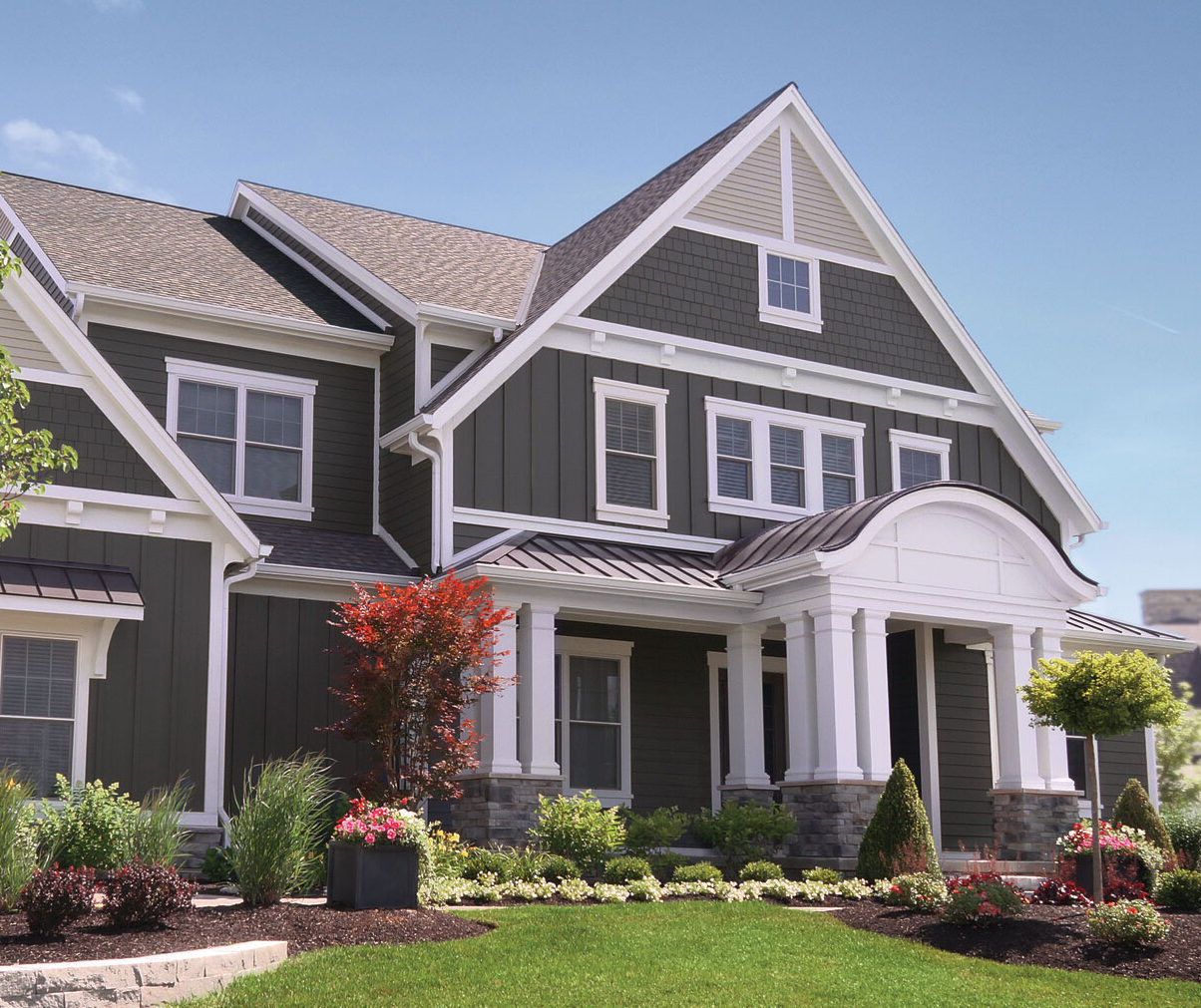
Both products offer realistic wood-grain textures, but LP SmartSide has a slight edge in authenticity. Because it’s made from actual wood strands, the grain pattern looks and feels more natural under close inspection. Hardie’s embossed textures look excellent from the street but can have a slightly more manufactured look from a foot away.
James Hardie offers a broad factory-applied color palette through ColorPlus Technology, with hundreds of colors available and a 15-year finish warranty. LP SmartSide ships primed and ready for field painting, which gives you unlimited color options but means you’re paying for the paint and labor separately.
Profile options are comparable. Both brands offer lap siding, vertical panels, shingles, and coordinating trim. If you’re pairing a full siding replacement with a roof replacement, coordinating those exterior materials at once often saves money on labor and produces a cleaner finished look.
Comparing Warranties: 30-Year vs. 5/50-Year
James Hardie offers a 30-year non-prorated transferable warranty on the substrate. If you use ColorPlus factory-applied finish, you get an additional 15-year finish warranty. The value of coverage doesn’t decrease over time. What’s covered in year one is covered in year 25.
LP SmartSide offers a 5-year finish warranty and a 50-year limited substrate warranty. That 50-year headline sounds impressive, but “limited” means the coverage prorates after the initial period, meaning your warranty protection decreases as the product ages. The 5-year finish warranty is also notably short, especially since field-applied paint is more vulnerable to weather than a factory finish.
For warranty clarity and real-world protection, Hardie’s 30-year non-prorated warranty is more useful. LP’s 50-year number requires careful reading of the warranty document to understand what it actually covers at year 15 or year 30.
The Best Siding for Your Climate
Climate should heavily shape this decision, and it’s the single factor that turns a close comparison into a clear choice.
Humid and rainy climates (Pacific Northwest, Southeast): James Hardie wins. Cement’s inherent moisture resistance makes it the lower-risk option where sustained rainfall and high humidity are everyday conditions. LP SmartSide can work in these regions, but installation precision becomes even more critical.
Freeze-thaw climates (Midwest, Northeast): Both products perform well here. Hardie’s HardieZone system offers HZ5 and HZ10 formulations specifically engineered for freeze-thaw resistance. LP SmartSide’s flexibility helps it handle thermal expansion and contraction without cracking, which gives it a slight edge over standard fiber cement in extreme cold.
Hail-prone regions (Great Plains, parts of the South): LP SmartSide wins. Engineered wood flexes on impact rather than cracking. If you’ve dealt with cracked fiber cement planks after a hailstorm, you understand.
Wildfire zones (Western states, WUI areas): James Hardie comes out on top, without question. Non-combustible siding may be required by local building codes in these areas, and even where it isn’t required, fiber cement offers the greatest risk reduction.
Coastal and salt-air environments: Go with James Hardie. Salt exposure accelerates degradation of organic materials. Cement shrugs off salt, while LP SmartSide’s resin coating faces a harder fight against salt-air penetration over years of exposure.
For homeowners in the Mid-Atlantic and Northeast, freeze-thaw performance is the primary climate variable. Both products handle it, but the installation details at seams, windows, and trim are especially important in climates that cycle between wet winters and hot summers.
ROI and Resale Value
Fiber cement siding consistently ranks among the top-performing exterior upgrades for resale value, recouping 113.7% of its cost at resale nationally, putting it well ahead of most exterior renovation categories. James Hardie siding signals premium construction quality that buyers in competitive markets actively look for.
LP SmartSide also provides solid resale value, particularly for homes where the existing siding is visually tired or physically damaged. The lower upfront cost means a faster break-even point, even if the per-dollar return trails Hardie’s by a modest margin.
For homeowners planning to sell within 5-7 years, LP SmartSide’s lower cost and strong curb appeal may produce better net ROI. For those staying long-term, Hardie’s durability and lower maintenance frequency compound into better overall value across 20-plus years of ownership.
Which Siding Fits Your Home
Choose James Hardie (fiber cement siding) if:
- You live in a humid, coastal, or wildfire-prone climate
- You want the lowest possible long-term maintenance schedule
- You want the strongest warranty terms
- You plan to stay in your home for 15 or more years and want siding you won’t need to touch again
Choose LP SmartSide (engineered wood siding) if:
- Upfront budget is your primary constraint
- You live in a hail-prone region
- You want the most authentic wood-grain appearance
- You’re comfortable with slightly more frequent maintenance in exchange for cost savings today
Both products outperform vinyl and natural wood siding in durability and long-term value. The right choice depends on your climate, your timeline, and your budget, and a contractor who understands all three can help you land on the option that fits.
Whether you’re replacing aging vinyl, damaged wood, or siding that’s reached the end of its life, pair the project with a roof replacement and you’ll typically see better total-project value than tackling each separately.
Here’s the product that wins in key areas:
| James Hardie | LP SmartSide | |
|---|---|---|
| Fire Resistance | ✓ | |
| Moisture Resistance | ✓ | |
| Impact Resistance | ✓ | |
| Pest Resistance | ✓ | ✓ |
| Upfront Cost | ✓ | |
| Lifespan | ✓ | |
| Warranty | ✓ | |
| Maintenance Frequency | ✓ | |
| Wood-Grain Authenticity | ✓ |
Find Out Which Siding is Best for Your Home
Home Genius Exteriors provides free inspections that pinpoint whether James Hardie or LP SmartSide makes more sense for your climate, budget, and home. Our team can walk you through both products side by side so you can compare performance, not just price. Call today to schedule your inspection and get a recommendation built around your home’s specific needs.
Frequently Asked Questions
Can I install James Hardie or LP SmartSide over existing siding?
Sometimes, but it depends on what’s already on the house and whether the wall assembly is flat, sound, and properly flashed. Many contractors recommend a full tear-off to inspect sheathing, address any moisture issues, and install a current-standard weather-resistive barrier underneath for best long-term performance.
What should I ask a contractor before choosing a siding material?
You can ask how they handle flashing at windows, doors, and rooflines, and whether they follow the manufacturer’s installation manual for clearances and fastening schedules. Also ask how they plan to manage rain exposure during installation and what their cleanup protocol is for cutting debris, especially with fiber cement, which produces silica dust.
How do these siding products affect home insulation and energy efficiency?
Siding itself isn’t a major insulating layer, but a siding replacement project is a good opportunity to add continuous exterior insulation, upgrade the weather-resistive barrier, or improve air sealing behind the cladding. Ask your installer about insulated sheathing options and how they detail penetrations to reduce air infiltration.
Are both products compatible with rainscreen systems?
Yes. A ventilated rainscreen gap behind the cladding improves drying and reduces paint stress in wet climates. The key is using the correct furring strip thickness and properly flashed drainage details, then following the product-specific fastening requirements. Both Hardie and LP SmartSide have published guidelines for rainscreen installations.
What are the most common reasons siding projects fail prematurely?
Most problems trace back to water management: missing or improper flashing, incorrect clearances to rooflines and grade, and caulk used as the primary moisture defense where it shouldn’t be. Choose an experienced installer and ask for documented installation standards.
How do I get a consistent look across siding, trim, soffit, and fascia?
Plan the trim details early (thickness, corner profiles, window surround design) and confirm availability and lead times for all accessory pieces. A coordinated trim plan also controls water entry at transitions, because details are only as good as how consistently they’re applied across the whole house.
Beyond repainting, what maintenance should I budget for?
Plan for periodic checks of caulk joints, penetrations (hose bibs, exterior outlets, vents), and any areas where roof runoff or grade drainage can splash against the wall. Keep gutters and downspouts clear, and address small cracks or dents promptly.
Does Home Genius Exteriors install both James Hardie and LP SmartSide?
Yes. Home Genius Exteriors installs both products. During a free inspection, we’ll walk through which material makes more sense for your specific home, climate exposure, and budget, with no pressure to choose on the spot.