Hardie Board Siding vs. Vinyl Siding
Many homeowners looking into siding options end up agonizing over sticker prices. The real value comes from what each material actually costs over 20 or 30 years. If you’re hoping to save money with vinyl siding vs. Hardie board (fiber cement), you may end up with expensive regrets: Hardie board comes with a higher cost largely because of the quality difference.
Your decision should hinge on several variables: how long you plan to stay in the house, the demands of your climate, and what the siding does to resale value when it’s time to sell. Run those numbers alongside the upfront cost, and the right answer becomes much clearer (and often different from what the lowest bid suggests).
Quick Answer: Should You Choose Hardie Board or Vinyl Siding?
Hardie board (fiber cement) costs more upfront, typically $8-$14 per square foot installed versus $4-$9 for vinyl, but is fire resistant, has a longer lifespan (30-50 years vs. 20-40), performs better in extreme climates, and has stronger resale value. That said, vinyl is a solid choice for tight budgets and temperate climates.
What Is Hardie Board Siding?
“Hardie board” is the brand name most people use when they mean fiber cement siding, much like “Band-Aid” for adhesive bandages. James Hardie manufactures roughly 90% of the fiber cement siding sold in North America, which is why the terms are used interchangeably. The product itself is a composite of Portland cement, sand, and cellulose fibers pressed into planks, shingles, or panels.
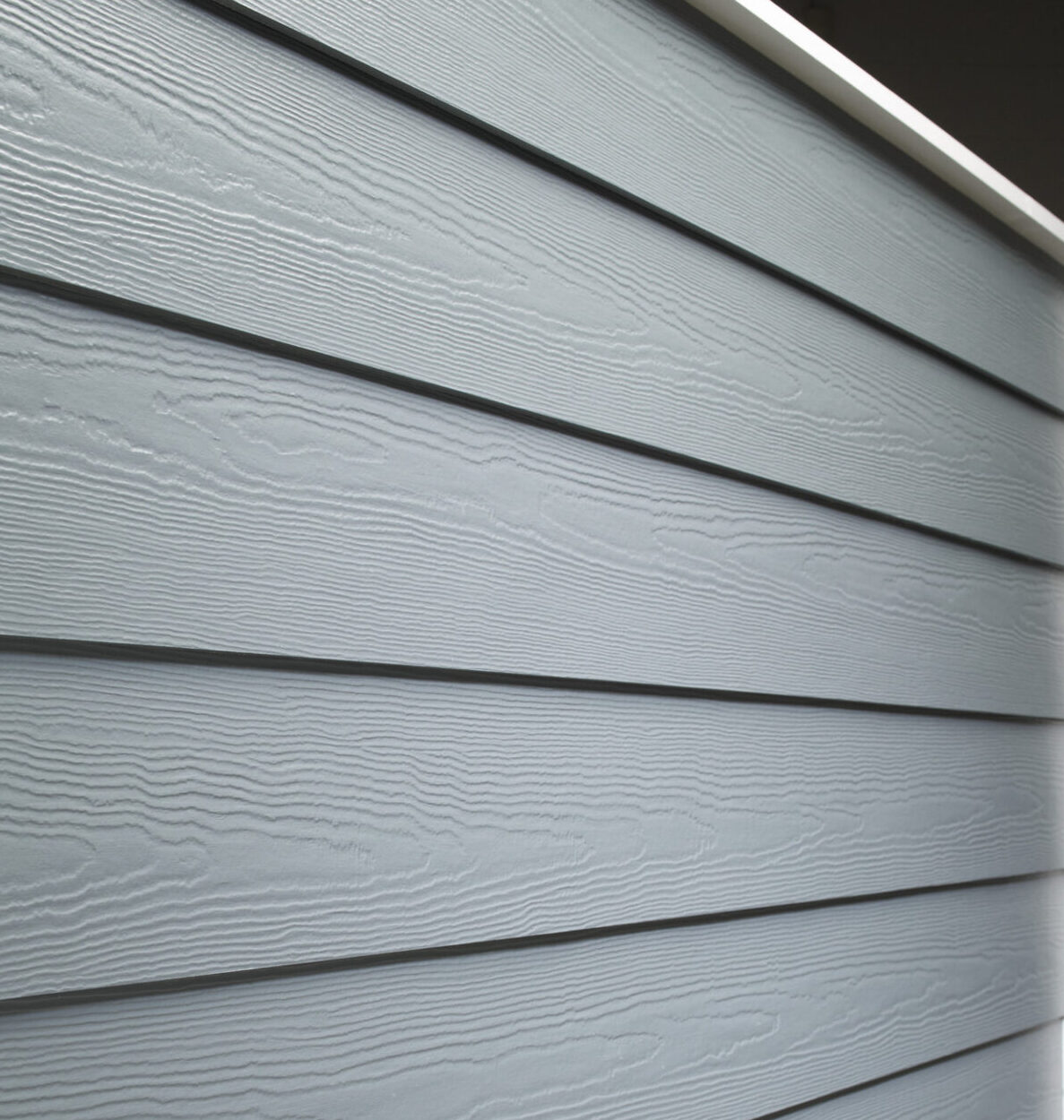
Vinyl siding, by contrast, is made from polyvinyl chloride (PVC) resin that’s extruded into lightweight panels designed to mimic wood grain. By volume, vinyl dominates the market. Both materials are popular choices, well-supported by contractors, and available in a wide range of styles.
Fiber cement’s composition gives it fundamentally different performance characteristics than plastic-based vinyl. Those differences carry through every category below.
Differences Between Hardie Board and Vinyl Siding
The table below gives you a high-level picture of key differences between these two common siding materials:
| Factor | Hardie Board (Fiber Cement) | Vinyl Siding |
|---|---|---|
| Installed Cost (per sq ft) | $8-$14 | $4-$9 |
| Typical Full-House Project | ~$21,000+ | ~$18,000 |
| Lifespan | 30-50 years | 20-40 years |
| Maintenance | Repaint every 10-15 years; periodic caulk touch-ups | Occasional power washing; no painting |
| Fire Resistance | Non-combustible (Class A rated per ASTM E84) | Melts at ~165 degrees F; not fire-resistant |
| Impact Resistance | High (resists hail and debris) | Moderate (can crack in extreme cold) |
| Appearance | Deep wood-grain texture; fully paintable | Uniform finish; limited to factory colors |
| Resale ROI | Fiber cement recoups a significant portion of its cost at resale | Vinyl recoups a strong portion of its cost at resale |
| Eco Considerations | Longer replacement cycle; recyclable components | PVC-based; shorter replacement cycle |
Hardie Board vs. Vinyl Cost Comparison
Vinyl has a much lower upfront cost. A typical vinyl job costs around $18,000 for a full home, while fiber cement averages over $21,000 (roughly 15-20% more).
Material costs for vinyl run $2-$4 per square foot, while Hardie board is $4-$8 per square foot. Labor is where the gap widens further. Fiber cement is heavier, requires specialized cutting tools (with silica dust precautions), and calls for experienced installers. Expect labor for Hardie board to run 30-50% higher than vinyl installation.
Other costs often include tear-off and disposal of old siding, new trim and flashing, moisture barriers, and permits. Hardie board also requires priming and painting if you don’t buy the pre-finished ColorPlus option, which adds another $1-$2 per square foot. A thorough pre-project inspection, checking for rotted sheathing, improper window flashing, and insect damage also prevents costly surprises mid-project and is worth requesting before signing anything.
Why Hardie Board is a Better Long-Term Investment
Vinyl siding may be cheaper up front, but it typically needs replacement around the 25-year mark. Hardie board can last 40-50 years with proper maintenance. That means homeowners choosing vinyl siding may face a second full project within the same timeframe that Hardie board covers with just one or two repaint cycles.
A repainting job every 12-15 years costs roughly $3,000-$6,000 for an average home. Two repaints over 40 years adds $6,000-$12,000. An entirely new vinyl siding project adds $18,000 or more.
The long-term cost picture almost always favors Hardie board for homeowners who plan to stay in their home for 15 years or more.
Durability, Fire Resistance, and Weather Performance
Hardie board’s cement-and-fiber composition makes it tough. It resists termites, won’t rot from moisture exposure (when properly installed), and holds up well against hail and wind-driven debris. It’s also non-combustible with a Class A fire rating and a flame spread index of 0. For homes in wildfire-prone areas, this could be a life-saving decision.
Vinyl holds its own in moderate conditions. It sheds water well and resists insect damage. But vinyl is weaker in extreme temperature. In severe cold, it becomes brittle and can crack on impact. In intense heat, panels warp and buckle. These are common complaints in climate zones that swing from sub-zero winters to 95-degree summers.
Fiber cement doesn’t expand and contract as aggressively as vinyl with temperature swings. James Hardie engineers region-specific products through their HardieZone system, designed for either high-humidity or freeze-thaw environments. That level of climate-specific engineering isn’t available in the vinyl category.
However, Hardie board can absorb moisture if the paint seal degrades, which leads to cracking in freeze-thaw cycles. This is almost always an installation or maintenance failure, not a material flaw. Proper flashing, caulking, and timely repainting prevent it entirely.
Energy Efficiency and Insulation
Neither siding material is a high-performance insulator on its own. Standard vinyl siding and fiber cement both have R-values well below 1.0 when installed alone. Where they differ is in how each fares with insulated backing.
Insulated vinyl siding, which pairs vinyl with a foam core bonded to the back, provides R-values between 2.0 and 3.5 depending on the product, making it one of the stronger performers when energy efficiency is the primary goal. You can also pair fiber cement with continuous exterior foam insulation to reach comparable R-values, but that adds cost to an already higher-priced material.
If energy performance matters to you, ask about insulated backing options for either material during your quote process. The insulation upgrade often recoups costs faster than the siding itself through reduced heating and cooling costs, and it can be integrated into the same project without significant added complexity. Before work begins, your contractor should be able to show how insulation will be detailed around windows, trim, and moisture barriers.
It’s a good idea to consider replacing old windows during a siding project by hiring a contractor to install everything in one go. Bundling services prevents future disruptions to your siding work.
Appearance, Curb Appeal, and Versatility
Hardie board comes with a deeper, more convincing wood-grain texture than any vinyl product on the market. It comes in lap siding, board and batten, shingle, and vertical panel profiles. You can paint it any color you want, and the ColorPlus factory-finish option bakes color into the material for excellent fade resistance.
Vinyl offers a solid range of colors and profiles, but you’re locked into factory options. While some premium vinyl lines mimic wood grain reasonably well, the uniform sheen gives it away up close. Vinyl also can’t be painted effectively because paint doesn’t adhere reliably to PVC.
For homeowners in neighborhoods with strict HOA requirements or those trying to match a specific architectural style, Hardie board’s paintability is a plus. You’ll never hear “sorry, that color isn’t available” from a fiber cement installer.
ROI and Home Resale Value
Fiber cement siding recoups roughly 114% of its cost at resale nationally, making it one of the strongest-performing exterior upgrades by return. Real estate agents consistently rank fiber cement siding as a premium exterior finish. Homes with Hardie board signal quality to buyers in a way vinyl doesn’t, and in markets where buyers are actively comparing homes, that perception difference often translates into offers.
Vinyl doesn’t hurt resale value, but it doesn’t boost it the way fiber cement does. If you’re planning to sell within five to seven years, the ROI calculation gets tighter. You might not fully recoup Hardie board’s higher upfront cost in a quick sale unless your local market specifically rewards premium exteriors.
Which Siding Is Better for Your Climate?
Here’s specific guidance based on where you actually live:
Cold Climates with Freeze-Thaw Cycles (Upper Midwest, Northeast)
Hardie board wins here, provided it’s installed correctly with proper moisture management. Vinyl becomes brittle in sub-zero temperatures, and a stray baseball or falling branch can shatter a panel. Fiber cement holds its shape and strength regardless of temperature. In regions where freeze-thaw cycles are a seasonal reality, this durability difference matters profusely year after year.
Hot, Humid, and Coastal Regions (Southeast, Gulf Coast)
Hardie board is the stronger choice again. It resists moisture absorption when sealed, won’t warp in sustained heat, and handles salt air better than vinyl. Vinyl in Gulf Coast heat often shows waviness along south-facing walls within 10 years.
Temperate and Moderate Climates (Pacific Northwest, Mid-Atlantic Mild Zones)
This is where vinyl becomes a reasonable pick. Without extreme temperature swings, vinyl’s weaknesses rarely surface. If your budget is tight and you live in a mild climate, vinyl offers good performance at a significantly lower price point.
Wildfire-Prone Areas (Western States, Mountain Communities)
Hardie board is the responsible choice. Its Class A fire rating means it won’t ignite from ember exposure. Vinyl melts and produces toxic fumes. Many fire-prone communities now require non-combustible exterior materials by code, and fiber cement meets those requirements.
Final Consensus: Hardie Board or Vinyl Siding?
There’s no one-size-fits-all answer. Your best siding depends on your specific priorities.
Choose Hardie Board if:
- You plan to stay in your home 15+ years
- You live in a climate with extreme heat, cold, or wildfire risk
- Curb appeal and architectural detail matter to you
- You want to paint your siding a custom color now or later
- Long-term cost of ownership outweighs upfront savings
Choose Vinyl if:
- Your budget is the primary constraint
- You live in a temperate climate without severe weather extremes
- You want minimal maintenance with zero painting
- You’re planning to sell within five to seven years
- Fiber cement installer access in your area is limited
One note that applies to either choice: if your contractor isn’t experienced with fiber cement, don’t let them learn on your house. Bad Hardie board installation creates moisture problems that cancel out every advantage the material offers. Ask for documented project history and James Hardie certification before signing a contract. The same scrutiny applies to vinyl. Improperly lapped panels and skipped housewrap steps cause water intrusion that won’t show up until years later.
A full siding project is also a good time to address adjacent systems. If gutters are aging, replace them alongside new siding to avoid damage to finished work and reduce future labor costs. If roofing is also on your radar, the timing overlap with a siding project can reduce mobilization costs. A roof repair often costs far less than a full replacement, but the right choice depends on how much damage is hiding under the shingles.
Find Out Which Siding Fits Your Home
Home Genius Exteriors’ siding replacement services covers both Hardie board and vinyl, with every project backed by our Genius Limited Lifetime Warranty. We provide free inspections that pinpoint whether Hardie board or vinyl makes more sense for your climate, budget, and home, and financing options mean the cost difference between materials doesn’t have to make the decision for you. Call today to schedule your inspection and get a recommendation built around your home.
Frequently Asked Questions
How do I choose a qualified installer for fiber cement siding?
Ask how many fiber cement projects they’ve completed in the last 12 months and request recent references. Confirm they follow current manufacturer installation guidelines and that their crew has proper cutting equipment and silica dust controls. Correct handling affects both safety and long-term finish quality.
What questions should I ask when comparing siding quotes from contractors?
Request an itemized scope that specifies sheathing repairs, housewrap or weather barrier details, flashing approach, and trim materials. Make sure allowances and exclusions are clearly stated so you can compare bids on equal footing, not just the bottom-line number.
How do warranties differ between fiber cement and vinyl siding?
Warranties typically include separate coverage for the product and the installer’s workmanship, and terms vary widely by brand and contractor. Ask what’s covered for fading and cracking, whether moisture-related issues are included, and whether the warranty transfers if you sell the home.
Do I need to remove existing siding before installing new siding?
Re-siding over existing material is sometimes possible, but it can hide moisture damage and create uneven walls. It also complicates flashing around windows and doors. A contractor should inspect the substrate and explain when a full tear-off is the better long-term approach.
How do these siding options affect insulation and energy efficiency?
Neither material is a high-value insulator on its own, but performance improves significantly with insulated backing or exterior foam installed during the project. If energy savings are a priority, ask about a continuous insulation plan and how it integrates with trim and moisture control details.
What hidden issues should I check for before starting a siding replacement?
Common surprises include rotted sheathing, improper window flashing, and insect damage. A pre-project inspection, sometimes including moisture readings, helps prevent mid-project change orders and allows new siding to go onto a sound, dry surface.
Are there permitting or HOA approvals I should plan for with a siding project?
Many municipalities require permits for exterior cladding changes, especially if structural repairs or window modifications are involved. If you have an HOA, confirm approved profiles and colors in writing before ordering materials to avoid delays and rework.