Architectural Shingles vs. 3-Tab Shingles: Which Is Better for Your Roof?
The two most common asphalt shingle options are architectural shingles and 3-tab shingles. Both protect your home from the elements, but they differ significantly in construction, durability, cost, appearance, and lifespan. Those differences have real consequences for how long your roof lasts, how it weathers storms, and how much you spend over time.
In this guide, we explain exactly what each shingle type is, compare them across every category that matters to homeowners, and help you determine which option is the right fit for your home and budget.
(Spoiler alert: at Home Genius we always recommend architectural shingles. Read on to find out why!)
What Are 3-Tab Shingles?
A 3-tab shingle is a single-layer asphalt shingle with two evenly spaced cutouts along the bottom edge, creating three individual-looking tabs. Each shingle strip is typically 12 inches wide and 36 inches long, and weighs between 200 and 250 pounds per roofing square (100 square feet).
3-tab shingles have been a staple of North American residential roofing since the 1930s. They’re made from an asphalt-saturated fiberglass mat topped with ceramic mineral granules that protect against UV rays and weathering. When installed, they lay completely flat and create a clean, uniform, two-dimensional pattern across the roof.
Their main advantage is cost: 3-tab shingles are among the least expensive roofing options available. However, their single-layer construction makes them significantly more vulnerable to wind, hail, and long-term weathering than thicker alternatives. Because of this, most major manufacturers have been phasing out 3-tab shingles, meaning fewer color and style options are available than in previous years. If you ever need to repair or partially replace a 3-tab roof, it can be harder to find an exact match to the original color.
3-Tab Shingles: Pros
- Lower upfront cost: the least expensive asphalt shingle option available
- Lightweight and fast to install, reducing some labor costs
- Clean, uniform appearance suits traditional and older home styles
- Suitable for low-stakes applications such as garages, sheds, and rental properties
- Can be recycled and repurposed as paving material (however, recycling programs may be limited in your area)
3-Tab Shingles: Cons
- Shorter lifespan: typically 15–25 years, much less in harsh climates
- Low wind resistance: rated for 60–70 mph, making them vulnerable in storms
- More prone to damage from hail, thermal cycling, and wind uplift
- Higher long-term cost due to earlier replacement and more frequent repairs
- Declining availability: fewer color options and harder to match for repairs
- Minimal impact on home value compared to architectural alternatives
What Are Architectural Shingles?
Architectural shingles (also called laminated or dimensional shingles) consist of multiple layers of asphalt fused together over a heavier fiberglass base mat. This laminated construction creates a shingle that’s approximately 50% heavier per square than a standard 3-tab shingle, with stronger adhesives, denser granule coverage, and higher-quality asphalt throughout.
The layered design produces a three-dimensional, textured appearance that can closely mimic the look of cedar shakes, natural slate or other premium roofing materials, giving homeowners a high-end aesthetic without the associated price tag. Architectural shingles have become the dominant choice for new residential roofing in North America, having largely replaced 3-tab shingles over the past two decades.
They’re available in a wide array of styles, colors and performance tiers, from standard 30-year dimensional shingles or Class 4 impact-resistant options engineered for hail-prone regions, to polymer-modified shingles designed for maximum flexibility in extreme temperatures.
Architectural Shingles: Pros
- Significantly longer lifespan: 25–50 years depending on product and climate
- Superior wind resistance: rated for 80–130 mph, with premium lines reaching 150 mph
- Better hail and impact resistance, especially in Class 3 and Class 4 rated products
- Wide variety of styles and colors that enhance curb appeal and complement home design
- Better warranties: typically 30 years to lifetime coverage
- Increases home resale value and improves buyer perception
- Class 4 shingles can lower homeowners insurance premiums by 20–30% in storm prone regions
Architectural Shingles: Cons
- Higher upfront material and installation cost: typically $5–$9 per sq ft installed
- Heavier weight may require structural assessment on older homes
- Requires professional installation for warranty validity and optimal performance
3-Tab vs. Architectural Shingles: Side-by-Side Comparison
| Category | 3-Tab Shingles | Architectural Shingles |
|---|---|---|
| Construction | Single layer of asphalt | Multiple laminated asphalt layers |
| Appearance | Flat, uniform, 2-dimensional | Textured, dimensional, 3D look |
| Standard size | 12″ × 36″ | ~13″ × 39″ (metric sizes common) |
| Weight per square | 200–250 lbs | 250–400 lbs (~50% heavier) |
| Wind resistance | 60–70 mph | 80–130 mph (up to 150 mph premium) |
| Lifespan | 15–25 years | 25–50 years |
| Warranty | 20–30 years | 30 years to lifetime |
| Impact resistance | Standard | Class 3 or Class 4 options available |
| Insurance savings | None | Up to 20–30% with Class 4 shingles |
| Installed cost | $3–$5 per sq ft | $5–$9 per sq ft |
| Style choices | 1 design, limited colors | Many styles, wide color range |
| Property value | Minimal impact | Increases resale value |
| Popularity | Being phased out by manufacturers | The standard for new installs |
What are Architectural Shingles and 3-Tab Shingles Made Of?
Both shingle types share the same foundational ingredients: asphalt, a fiberglass reinforcement mat, and ceramic mineral granules on the exposed surface. The biggest differences are in quantity and quality of materials.
Architectural shingles use more asphalt, more granules, and higher-grade asphalt than 3-tab shingles. The fiberglass base mat is thicker. The adhesive strips that bond adjacent shingles together are stronger. The total weight runs 250–400 pounds per square, compared to 200–250 pounds per square for a 3-tab. That additional mass (roughly 50% more material overall) is what gives architectural shingles their superior durability, wind resistance, and impact performance.
3-tab shingles are thinner at approximately 3/16 of an inch and laid flat, which means all the stress from wind, hail, and thermal expansion falls on a single asphalt layer. The individual tab cutouts also create channels where water concentrates and impacts the underlying shingle with greater force, which accelerates granule loss and long-term wear at the cut points.
How Long Do Architectural Shingles and 3-Tab Shingles Last?
Architectural shingles substantially outperform 3-tab shingles for long-term durability. Their multi-layer construction resists curling, cracking, and granule loss far better under repeated exposure to heat, cold, UV radiation, and moisture cycling.
In standard conditions, architectural shingles last 25–30 years, with top-tier products from manufacturers like Owens Corning lasting 40–50 years. In harsh climates with extreme heat, heavy snow, or frequent storms, that advantage widens further: 3-tab shingles may need replacement in as few as 10–15 years in severe-weather regions, while architectural shingles continue performing.
3-tab shingles, by contrast, have a typical lifespan of 15–25 years in moderate climates. Their lighter, single-layer construction makes them more susceptible to wind uplift, hail dents, and temperature-driven expansion and contraction, all of which accelerate deterioration.
Wind Resistance
One of the biggest performance differences between architectural shingles and 3-tab shingles is wind resistance. It’s also one of the most important considerations for homeowners in storm-prone areas.
Standard 3-tab shingles are usually rated for wind speeds of 60–70 miles per hour. Their thin, flat profile and individual tab design create more surface area for wind to catch beneath, making them prone to lifting and blow-off during severe storms. In areas that regularly see thunderstorms, nor’easters, or hurricane-force gusts, this is a serious limitation.
Architectural shingles are engineered for wind speeds of 80–130 miles per hour, with premium impact-resistant lines rated up to 150 mph. Their heavier laminated construction lies closer to the roof deck, resists lifting, and their varied tab sizes reduce the uniform pattern that wind can exploit to peel shingles back from a single edge. Some premium architectural shingles (like the Owens Corning Duration series) meet Miami-Dade County’s stringent wind code requirements, which are among the toughest in the country.
Impact Resistance and Insurance Savings
Asphalt shingles are tested and rated for hail impact resistance on a scale from Class 1 (least resistant) to Class 4 (most resistant) using the UL 2218 steel ball test. Standard 3-tab shingles receive no impact classification. Most standard architectural shingles earn a Class 3 rating. Class 4 architectural shingles (including Owens Corning’s Duration STORM and Duration FLEX lines) are engineered to withstand impacts from 2-inch hailstones without cracking or rupturing.
That Class 4 rating comes with financial benefits. As mentioned earlier, many homeowners insurance carriers offer discounts of 20–30% on roof premiums for homes with Class 4 impact-resistant shingles. On a typical homeowner’s policy, that can translate to hundreds of dollars in annual savings that, over the life of the roof, can substantially offset the higher upfront cost of the upgrade.
For homeowners in hail-prone states, this is often the best argument for choosing a Class 4 architectural shingle. We recommend calling your insurance provider before committing to a shingle product, as discount availability and amounts vary by carrier and region.
How Much do Architectural Shingles Cost vs. 3-Tab Shingles?
Upfront costs
3-tab shingles have a lower material cost: about $0.80–$1.20 per square foot for materials alone. Installed (including labor, underlayment, and basic accessories) they’re around $3–$5 per square foot, or $300–$500 per roofing square.
Architectural shingles cost more per square foot for materials, typically $1.25–$2.50, and $5–$9 per square foot installed, or $500–$900 per roofing square. For a standard 2,000 square foot roof (approximately 20 squares), that represents a total installed cost difference of roughly $4,000–$8,000 between the two options.
Long-term cost of ownership
A homeowner who installs a 3-tab roof today may need to replace it in 15–20 years. An architectural shingle roof installed at the same time could still be performing at year 30, 40, or beyond. On a 30-year timeline, a 3-tab roof may require two full replacements while one architectural roof is still going. So the “cheaper” option could end up costing significantly more over time.
For example:
A 20-square, 3-tab roof at $400/square = $8,000.
The same roof using architectural shingles at $700/square = $14,000.
The difference is $6,000. If the 3-tab roof is replaced at year 20 for another $8,000, the 30-year spend on 3-tab is $16,000 vs. $14,000 for one architectural roof, and the architectural shingles are still on the house.
Add in fewer repairs, stronger insurance discounts, and higher resale value, and the long-term financial case for architectural shingles is compelling for most homeowners who plan to stay in their home.
Curb Appeal and Design Options
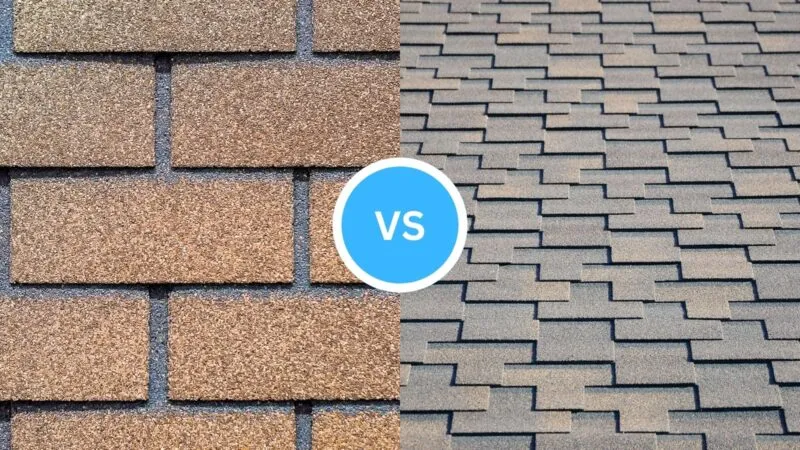
Architectural shingles look much nicer than 3-tab shingles. The dimensional profile creates depth and shadow lines that give a roof genuine visual character and mimic the look of cedar shakes, natural slate, or other premium materials at a fraction of the cost. They come in dozens of colors and profiles, and the varied tab shapes prevent the monotonous repeating pattern that makes 3-tab roofs look flat and dated.
3-tab shingles do have a clean, uniform look that suits many traditional home styles and older neighborhoods where that classic profile fits naturally. But design options are limited and getting worse as time goes on, as manufacturers reduce their 3-tab color lines in response to declining demand. If curb appeal or home value enhancement is a priority, architectural shingles are the stronger choice.
It’s also worth noting the resale angle: architectural shingle roofs add value to your home, especially when the roof is newer and the shingles are visually distinctive.
Installation and Maintenance
Installation complexity is another point where architectural and 3-tab shingles differ.
3-tab shingles are lighter and uniform in size, making them faster and easier to install. Their consistent shape allows for straightforward layout and nailing patterns, which is part of why they became popular for budget projects and DIY applications. However, their lighter weight and thinner profile means they must be installed with precise nail placement. Overdriven or angled nails can compound the wind vulnerability of 3-tab shingles, which are rated for only 60-70 miles per hour.
Architectural shingles are heavier and require more precise placement due to their varied tab sizes and laminated thickness. The installation process takes more time and skill, which is why manufacturer warranties typically require professional installation by a certified contractor. Improper installation of architectural shingles can void the product warranty and significantly compromise performance. At Home Genius Exteriors, our installations are performed by Owens Corning Platinum Preferred contractors, so you don’t need to worry about warranty compliance or craftsmanship.
For maintenance, architectural shingles come out on top. Their thicker profile better masks minor imperfections in the roof deck, better resists granule loss, and handles the repeated thermal expansion and contraction of seasonal temperature swings without cracking. 3-tab shingles require more vigilant inspection and more frequent repair, especially in the years approaching the end of their warranty period and tab lifting and granule loss accelerate.
Both shingle types require the same basic maintenance: annual inspections, keeping gutters clear, trimming overhanging branches, and addressing any damaged shingles promptly before water infiltrates the roof deck.
Minimum Roof Pitch Requirements
Both 3-tab and architectural asphalt shingles require a minimum roof slope of 4:12, which means the roof rises at least 4 inches for every 12 horizontal inches. Neither type of shingle is appropriate for flat or low-slope roofs. If your roof falls below that threshold, you’ll need to look into low-slope roofing materials such as modified bitumen or TPO membranes. If you’re unsure of your roof’s pitch, a professional inspection will measure it and confirm which roofing systems are compatible.
Market Trends and Availability
Architectural shingles now account for the majority of new residential roofing installations. Most professional roofing contractors default to architectural shingles for full replacements because the performance, warranty, and value case is simply stronger for most homeowners.
3-tab shingles are still produced and available, but their market presence is dwindling. Manufacturers have been reducing color lines and phasing out certain product tiers as demand shifts toward architectural and premium impact-resistant options. This has a practical consequence for anyone with an existing 3-tab roof: as years pass, finding an exact color match for repairs becomes more difficult, and in some cases, impossible.
When we’re called to repair a 3-tab roof where the original color has been discontinued, we often recommend replacing the full roof rather than patching with a visibly mismatched shingle.
Which Shingle Type Should You Choose?
For most homeowners replacing a roof on their primary residence, architectural shingles are the better investment. They last longer, perform better in storms, carry stronger warranties, enhance curb appeal, and deliver a lower total cost of ownership over a 20–30 year horizon.
That said, there are circumstances where 3-tab shingles might be your ultimate choice.
Choose 3-tab shingles if:
- You have a very tight budget and are roofing a non-primary structure like a garage, shed, or outbuilding where longevity and aesthetics are secondary.
- You own a rental property and need the lowest possible upfront cost, and the property will be sold or redeveloped before the roof needs replacement.
- You need to match an existing 3-tab roof for a partial repair, and a full replacement isn’t in scope.
- You live in a mild climate with low wind and hail exposure, and you don’t plan to stay in the home for more than 10 years.
Choose architectural shingles if:
- You want a longer-lasting, more durable roof.
- You live in an area prone to harsh weather conditions like hail, heavy snow, or hurricanes.
- You care about boosting your home’s curb appeal and resale value.
- You prefer a low-maintenance, worry-free roof that will stand the test of time.
For any homeowner staying in their home long-term, values curb appeal, or lives in a region with meaningful storm exposure, choose architectural shingles for your roof replacement project.
The Home Genius Recommendation
At Home Genius Exteriors, we proudly install premium Owens Corning architectural shingles, delivering exceptional durability, beauty, and performance for homeowners. Our shingle offerings combine industry-leading technology with a wide range of styles to fit any home.
Owens Corning Duration® Collection
The Duration® series features bold TruDefinition® colors and a dimensional look, built with patented SureNail® Technology for enhanced wind resistance up to 130 mph. With built-in StreakGuard® algae protection and a limited lifetime warranty, these shingles offer lasting curb appeal and strong protection.
Duration FLEX®
Engineered with SBS polymer-modified asphalt for enhanced flexibility in extreme cold, Duration FLEX shingles resist cracking during freeze-thaw cycles, making them particularly well-suited to our markets in Pennsylvania, Ohio, Michigan, and other northern states. They carry a Class 4 impact rating.
Duration STORM®
The highest-performance option for hail and storm-prone areas, Duration STORM shingles feature patented WeatherGuard Technology and carry a Class 4 impact resistance rating, making them eligible for significant homeowners insurance discounts in storm-prone markets.
Owens Corning Total Protection Roofing System®
Home Genius Exteriors installs the full Owens Corning Total Protection Roofing System®, including moisture-resistant underlayment, advanced attic ventilation, and matching ridge shingles. As a Platinum Preferred Contractor, we also offer exclusive extended warranties for added peace of mind.
Why Architectural Shingles Are The Better Choice
In nearly every important category—durability, weather resistance, appearance, and lifespan—architectural shingles outperform 3-tab shingles. While 3-tab shingles offer an affordable entry point for roofing, they come with shorter service lives, less curb appeal, and higher maintenance needs.
For homeowners planning to stay in their home long-term or those who value beauty and resilience, architectural shingles are a more strategic investment. Their higher upfront cost is easily justified by their longer lifespan, reduced maintenance, improved energy efficiency, and the enhanced value they bring to your property.
If you’re ready to explore your roofing options, Home Genius Exteriors can help. Our team of certified roofing experts can help you choose the perfect shingles for your home and budget, and ensure your roof is installed with the highest level of craftsmanship and care. Contact us today for a free inspection and estimate.
Frequently Asked Questions
Is it worth upgrading from 3-tab to architectural shingles?
For most homeowners, yes. Architectural shingles cost more upfront (typically $2,000–$6,000 more for an average roof) but they last 10–25 years longer, require fewer repairs, and can reduce homeowners insurance premiums with Class 4 impact ratings. The upgrade makes the most sense for homeowners who plan to stay in their home for more than 10 years, live in an area with wind or hail exposure, or care about curb appeal and resale value.
Can you tell the difference between 3-tab and architectural shingles from the street?
Yes. 3-tab shingles lie completely flat and create a uniform, repetitive brick-like pattern. Architectural shingles have visible depth and texture. They cast small shadows and the varied tab sizes create a more dynamic, dimensional look similar to wood shake or slate. From the street, architectural shingles give a roof a noticeably higher-end appearance.
How much more do architectural shingles cost than 3-tab?
The material cost difference is roughly $0.50–$1.30 per square foot. Installed, architectural shingles typically run $2–$4 more per square foot than 3-tab shingles. On a 2,000 square foot roof, that translates to a total installed cost difference of approximately $4,000–$8,000. However, given that architectural shingles can last twice as long, the per-year cost difference is often much smaller than the upfront number suggests; and in many cases reverses over a 30-year period when repair and replacement costs are factored in.
Can 3-tab and architectural shingles be mixed on the same roof?
It’s technically possible in some repair scenarios, but not recommended for new installations or full replacements. The two shingle types have different thicknesses and dimensions, making them difficult to blend seamlessly. Mixing them on a visible roof plane creates a mismatched and irregular appearance. For repairs, if a small area of 3-tab roof is damaged and the original color is still available, patching with matching 3-tab shingles is acceptable. If the color is discontinued or the repair area is significant, you may want to opt for a full roof replacement.
Are 3-tab shingles being discontinued?
3-tab shingles aren’t being discontinued outright, but they are being phased down. Most major manufacturers including Owens Corning, GAF, and CertainTeed have been reducing their 3-tab product lines over the past decade as market demand has shifted toward architectural shingles. Fewer colors, fewer product tiers, and reduced production runs mean 3-tab shingles are harder to match for repairs than they were 10–15 years ago. Choosing 3-tab today means potentially limiting your repair options in the future.
Which shingles are better for solar panel installation?
Architectural shingles are the better foundation for solar panels. Solar installations typically last 25–30 years, and removing and reinstalling panels to accommodate a roof replacement is expensive. Architectural shingles, with their longer warranties and greater durability, are far more likely to outlast the solar installation (or at minimum, align more closely in service life). The heavier, more rigid surface also provides a more stable mounting substrate for racking hardware.